How Are Heavy Equipment LED Work Lights Made?
Heavy equipment often works in conditions where natural light is limited. Early mornings, night shifts, tunnels, shaded areas and dusty jobsites can all make it harder for operators to see the work ahead.
That is where LED work lights come in.
Modern LED work lights are designed to provide bright, focused illumination while withstanding vibration, dust, moisture, temperature changes and the demands of heavy equipment. Although a finished work light may look like a relatively simple component, it combines electronics, optics, thermal management and rugged construction.
So, how are heavy equipment LED work lights made?
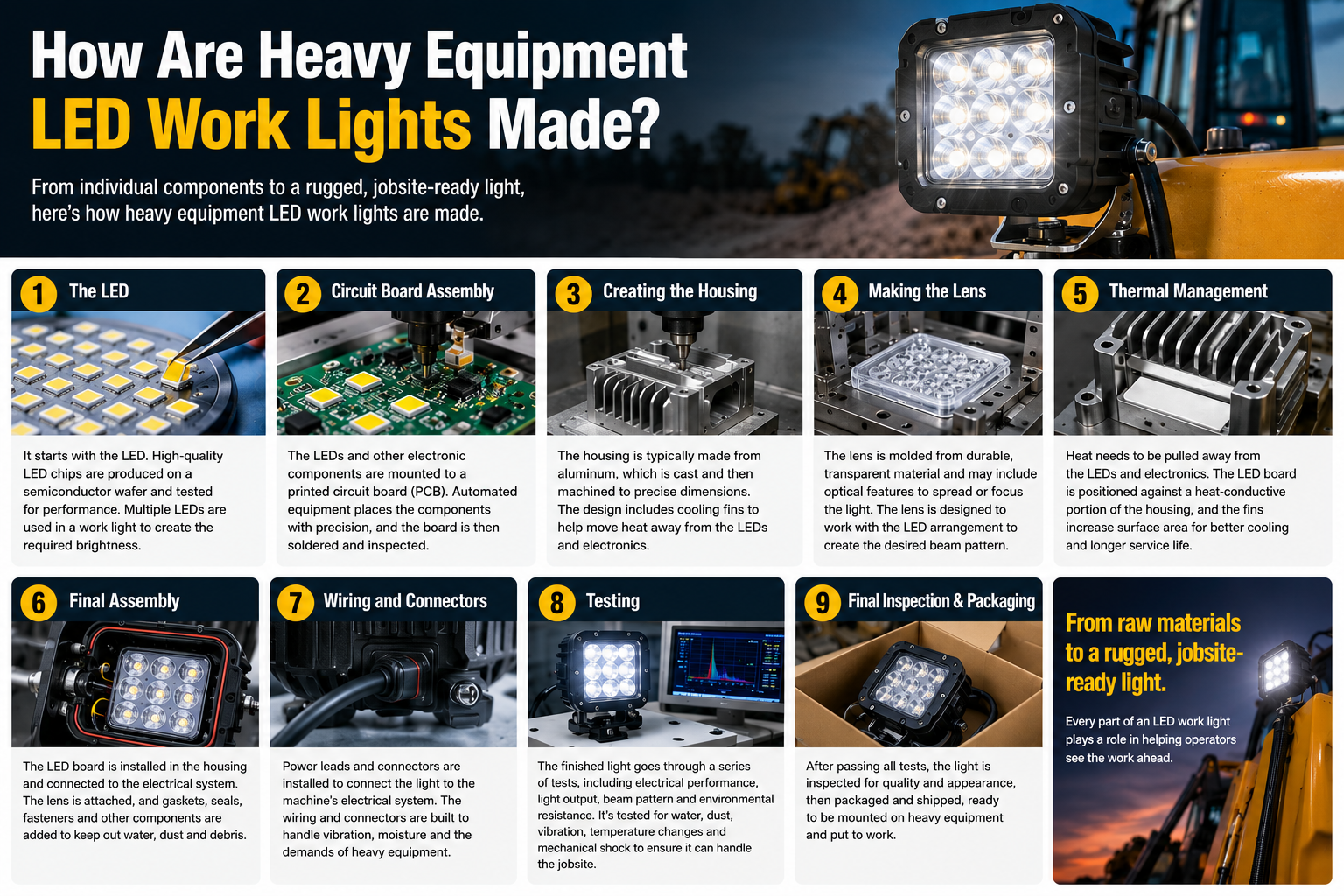
1. It Starts With the LED
The heart of an LED work light is the light-emitting diode, or LED. Unlike traditional incandescent bulbs, LEDs produce light when electrical current passes through a semiconductor material.
LED work lights typically use multiple LEDs mounted together to produce the required amount of light. The number, arrangement and type of LEDs can vary depending on the design, desired light output and beam pattern.
The LEDs are mounted onto a circuit board along with other electronic components that help control and manage the electrical current flowing through the light.
2. Building the Circuit Board
The LEDs are only one part of the electrical system.
A printed circuit board, or PCB, provides the foundation for the LEDs and other electronic components. Automated equipment can place tiny components onto the board with precise positioning before the board passes through a soldering process that secures the components in place.
Depending on the work light, the circuit board may contain components such as resistors, capacitors and a driver that regulates the power supplied to the LEDs.
Once assembled, the board can be inspected and tested to make sure the components are properly installed and function as intended.
3. Creating the Housing
A heavy equipment work light needs more than electronics. It also needs a housing capable of protecting those electronics from the environment.
Many work light housings are made from aluminum because the material is relatively lightweight while also providing strength and good heat-transfer characteristics.
The housing may be cast and then machined to achieve the required dimensions. Other designs can use formed or fabricated metal components.
The housing also often incorporates cooling fins or other features designed to help move heat away from the LEDs and electronics.
4. Making the Lens
The lens protects the LEDs while also helping control how the light is distributed.
Lenses are commonly produced from durable transparent or translucent materials that can withstand the conditions where the light will be used. The lens may incorporate patterns or other optical features that spread, focus or otherwise shape the beam.
Different lens designs can create different light patterns. A broad beam can illuminate a larger area around the machine, while a more focused pattern can project light farther ahead.
The lens is designed to work with the LED arrangement inside the housing to produce the desired beam.
5. Managing the Heat
LEDs are more efficient than many older lighting technologies, but they still generate heat.
Managing that heat is an important part of work light design because excessive temperatures can affect LED performance and service life.
The LED board is typically positioned against or near a heat-conductive portion of the housing. Heat moves from the LEDs and circuit board into the housing, where it can be dissipated into the surrounding air.
Some work light housings use fins to increase the surface area available for cooling. This allows heat to move away from the electronics more effectively.
For equipment operating in demanding environments, proper thermal management can be just as important as producing sufficient light.
6. Final Assembly
Once the major components are ready, the work light moves into final assembly.
The LED circuit board is positioned inside the housing and connected to the necessary electrical components. Depending on the design, the lens, fasteners, reflectors and other components are installed as part of the assembly. A mounting bracket may also be attached, providing a way to secure the finished light to the machine and, on some designs, adjust its direction.
Gaskets, adhesives or other sealing methods may be used to help keep moisture and contaminants out of the housing.
7. Wiring and Connectors
With the light assembled, power leads and connectors are installed to connect it to the machine's electrical system.
The wiring provides the electrical path needed to deliver power to the LEDs and other components. Connectors provide the connection between the work light and the equipment's electrical system and can be designed for the environmental conditions where the light will operate.
Because heavy equipment produces significant vibration and operates in demanding conditions, wiring and connectors need to be properly secured and protected.
The finished connections become another important part of making sure the light can operate reliably on the jobsite.
8. Testing
Before an LED work light reaches a machine, it can go through a series of inspections and tests.
Electrical testing verifies that the light operates correctly and that its components are functioning as intended. Light-output testing can measure characteristics such as brightness and beam distribution.
Manufacturers may also test the light's resistance to environmental conditions, depending on its intended application.
That can include:
- Water and moisture
- Dust and dirt
- Vibration
- Temperature changes
- Electrical fluctuations
- Mechanical shock
9. Final Inspection and Packaging
After testing, the work light goes through a final inspection to check its appearance, assembly and overall quality.
Inspectors can verify that components are properly installed, connections are secure and the housing and lens meet the required specifications. Any final adjustments or quality checks can be completed before the product is packaged.
Once it passes the final inspection, the light is packaged and prepared for shipment to equipment manufacturers, dealers or other customers.
The next time you see a bright beam illuminating a jobsite after dark, there is more going on inside that compact housing than meets the eye. What looks like a simple work light is the result of a combination of electronics, optics, thermal management and rugged construction, all designed to help operators see the work ahead.