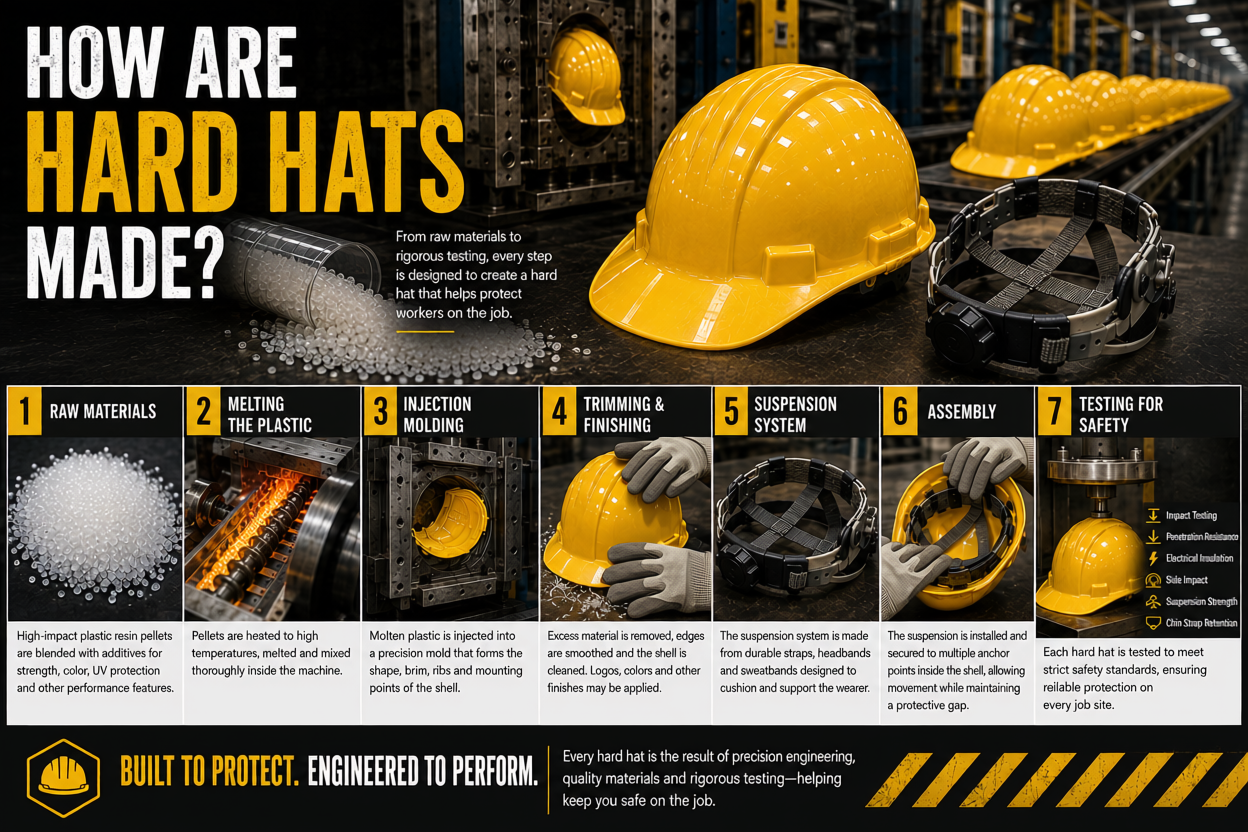
How Are Hard Hats Made?
Every day, millions of workers rely on hard hats to help protect them from falling objects, impacts, and other hazards on construction sites, industrial facilities, and road projects. While they may look like simple pieces of plastic, hard hats are carefully engineered safety equipment built to meet strict performance standards.
From the raw materials to the final quality inspections, every step of the manufacturing process is designed to create a helmet that can withstand demanding jobsite conditions. Here's a closer look at how hard hats are made.
What Are Hard Hats Made From?
Most modern hard hats consist of two main components:
- The outer shell – absorbs and distributes the force of impacts.
- The suspension system – cushions the wearer's head by creating space between the shell and the skull.
The shell is typically made from high-impact plastics, including:
- High-density polyethylene (HDPE)
- Acrylonitrile butadiene styrene (ABS)
- Polycarbonate
- Fiberglass composites (for specialized applications)
These materials are chosen because they combine strength, durability, lightweight performance, and resistance to chemicals, weather, and UV exposure.
Step 1: Preparing the Raw Materials
The manufacturing process begins with plastic resin pellets. These pellets are blended with various additives depending on the intended use of the hard hat.
Manufacturers may add:
- UV stabilizers to reduce sun damage
- Color pigments
- Impact modifiers for improved toughness
- Flame-retardant additives for specialized models
The blended material is carefully measured to ensure consistent quality throughout production.
Step 2: Melting the Plastic
The plastic pellets are fed into an injection molding machine.
Inside the machine:
- The pellets are heated to high temperatures.
- A rotating screw melts and mixes the material.
- Pressure builds before the molten plastic is injected into a precision steel mold.
This process ensures the shell is formed with consistent thickness and strength.
Step 3: Injection Molding the Shell
The molten plastic is forced into a mold shaped like a hard hat shell.
The mold includes important design features such as:
- The brim
- Internal reinforcement ribs
- Mounting points for the suspension
- Slots for accessories like face shields or earmuffs
After the mold is filled, the plastic cools and hardens before the finished shell is removed.
Step 4: Trimming and Finishing
Once removed from the mold, the shell is inspected and finished.
This stage may include:
- Removing excess plastic
- Smoothing edges
- Drilling or finishing accessory slots
- Cleaning the surface
Some manufacturers also apply logos, graphics, reflective markings, or custom branding before final assembly.
Step 5: Manufacturing the Suspension System
The suspension system is just as important as the shell.
It is typically made from woven nylon, polyester, or durable plastic straps and includes:
- Adjustable headbands
- Crown straps
- Sweatbands
- Ratchet or pin-lock adjustment systems
The suspension is designed to suspend the shell above the worker's head, helping absorb and spread impact energy during a strike.
Step 6: Assembly
Workers or automated equipment install the suspension system inside the shell.
Each suspension connects to multiple anchor points that allow the shell to move slightly during an impact while maintaining the protective gap above the head.
Manufacturers also verify that adjustments operate smoothly and securely.
Step 7: Testing for Safety
Before reaching customers, hard hats undergo extensive testing to verify they meet applicable safety requirements.
Common tests include:
- Vertical impact testing
- Penetration resistance
- Electrical insulation (for rated models)
- Side impact testing (where applicable)
- Suspension strength
- Chin strap retention (for helmets equipped with chin straps)
Manufacturers also perform routine quality inspections throughout production to ensure consistency between batches.
Why the Suspension Matters
One common misconception is that the plastic shell alone provides protection.
In reality, the suspension system plays a major role by:
- Creating space between the shell and the head
- Reducing transmitted impact forces
- Helping distribute energy across the helmet
- Improving comfort during long workdays
Without the suspension, a hard hat would provide significantly less protection.
Different Types of Hard Hats
Not all hard hats are designed for the same environments. Manufacturers produce different models for different hazards, including:
- General construction
- Highway work
- Mining
- Utility work
- Oil and gas
- Forestry
- High-temperature environments
- Electrical work
Some modern designs also include integrated eye protection, communication systems, face shields, or ventilation while maintaining safety performance.
Built for Tough Jobs
Although a hard hat may seem simple, it's the result of precise engineering, carefully selected materials, and rigorous testing. Every molded shell and suspension system is designed to help reduce the risk of head injuries in demanding work environments.
Whether you're operating an excavator on a construction site, working around cranes at a commercial project, or performing maintenance in an industrial facility, your hard hat is one of the most important pieces of personal protective equipment you wear.