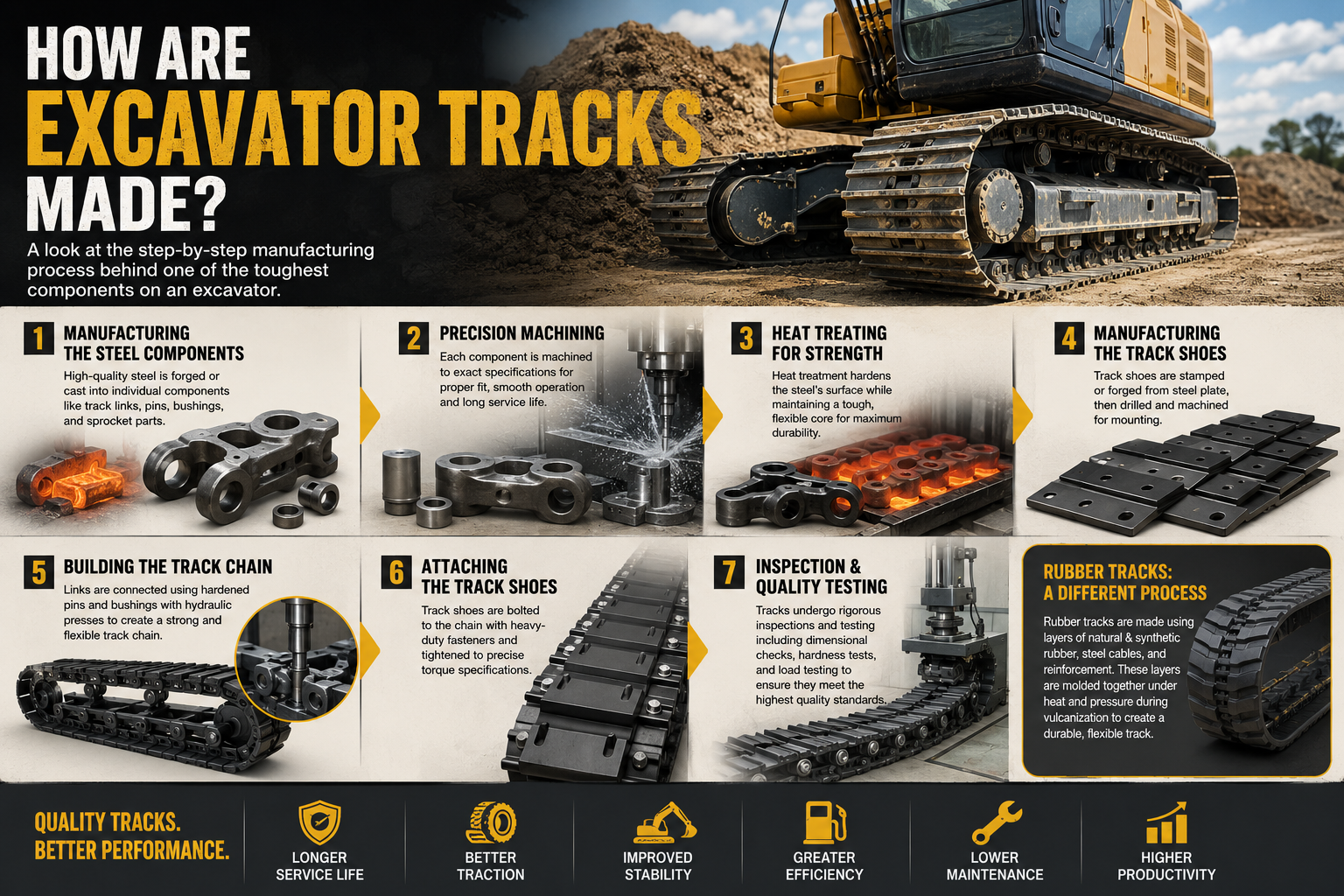
How Are Excavator Tracks Made?
Excavator tracks are built to handle some of the toughest working conditions on earth. Whether operating on rocky construction sites, muddy job sites, demolition projects or mining operations, tracks must support thousands of pounds while providing traction, stability and durability.
But how are these heavy-duty components actually made?
The manufacturing process combines high-strength steel, precision machining, heat treatment and rigorous quality testing to create tracks capable of withstanding years of demanding work.
Why Excavator Tracks Matter
Tracks do much more than move an excavator from one place to another. They:
- Distribute the machine's weight over a larger surface area
- Improve traction on uneven terrain
- Reduce ground pressure
- Increase stability while digging and lifting
- Help minimize sinking in soft ground
Because tracks endure constant impact, abrasion and heavy loads, every component must be manufactured to extremely tight standards.
Step 1: Manufacturing the Steel Components
The process begins with high-quality steel selected for its strength and wear resistance.
Several individual parts are manufactured separately, including:
- Track links
- Track pins
- Bushings
- Rollers
- Shoes (track pads)
- Sprocket contact surfaces
Large steel billets or bars are heated before being forged or cast into rough shapes. Forging aligns the steel's internal grain structure, creating stronger components that are less likely to crack under heavy loads.
After forming, the parts cool before moving to precision machining.
Step 2: Precision Machining
Each component is machined to exact specifications using CNC equipment.
Machining ensures:
- Accurate pin holes
- Smooth mating surfaces
- Proper tolerances
- Consistent dimensions
Even tiny variations can affect track performance or accelerate wear, so manufacturers maintain extremely tight quality standards throughout this stage.
Step 3: Heat Treating for Strength
Once machined, many components undergo heat treatment.
This process typically involves heating the steel to extremely high temperatures before carefully cooling it under controlled conditions.
Different methods may include:
- Induction hardening
- Through hardening
- Carburizing
- Quenching and tempering
The goal is to create components with a hard, wear-resistant outer surface while maintaining a tougher, more flexible core that resists cracking under heavy impact.
Pins and bushings are especially critical because they experience constant friction as the track articulates around the undercarriage.
Step 4: Manufacturing the Track Shoes
Track shoes are the wide steel plates that contact the ground.
These are usually stamped or forged from heavy steel plate before holes are drilled or machined for mounting bolts.
Depending on the excavator's application, manufacturers produce different shoe styles, including:
- Single grouser
- Double grouser
- Triple grouser
- Flat shoes for specialized applications
The shoe design influences traction, flotation and ground disturbance.
Step 5: Building the Track Chain
Assembly begins by connecting the individual track links using hardened pins and bushings.
Hydraulic presses install the pins with extremely precise force to ensure the correct interference fit.
The finished chain must remain flexible enough to articulate smoothly while being strong enough to withstand enormous pulling forces.
Some manufacturers lubricate sealed track chains during assembly before installing specialized seals that help keep grease in and contaminants out.
Step 6: Attaching the Track Shoes
Once the track chain is complete, the shoes are bolted onto the links.
Heavy-duty fasteners are tightened to precise torque specifications.
Proper torque is critical because loose hardware can damage the track, while excessive torque may overstress the bolts.
After installation, the completed track begins to resemble the familiar continuous loop found on excavators.
Step 7: Inspection and Quality Testing
Before leaving the factory, excavator tracks undergo extensive inspection.
Manufacturers may perform tests such as:
- Dimensional inspections
- Hardness testing
- Material analysis
- Ultrasonic crack detection
- Load testing
- Wear resistance testing
Many manufacturers also conduct fatigue testing to simulate years of field use under repeated loading.
Only tracks that meet strict quality standards move on to final packaging and shipment.
Rubber Tracks Follow a Different Process
Not all excavators use steel tracks.
Compact excavators often use rubber tracks, which are manufactured differently.
Instead of assembling individual steel links, rubber tracks are built using layers of:
- Natural and synthetic rubber
- Continuous steel cables
- Steel reinforcement plates
- Fabric reinforcement
These materials are molded together under heat and pressure during a process known as vulcanization, producing a flexible but durable endless track.
Why Quality Manufacturing Matters
A properly manufactured excavator track can significantly influence machine performance.
High-quality tracks often provide:
- Longer service life
- Improved fuel efficiency
- Better traction
- Reduced vibration
- Lower maintenance costs
- Increased productivity
Because the undercarriage is often one of the most expensive wear areas on an excavator, investing in well-built tracks can reduce operating costs over the life of the machine.
The Bottom Line
Although excavator tracks may appear simple from the outside, they're the result of sophisticated engineering and precision manufacturing. From forged steel components and advanced heat treatment to precision machining and rigorous quality testing, every step is designed to produce tracks that can withstand some of the harshest operating environments in the world.
The next time you see an excavator climbing over rocks, digging through tough soil or working on uneven terrain, remember that every movement depends on a carefully engineered track system built to endure countless hours of demanding work.