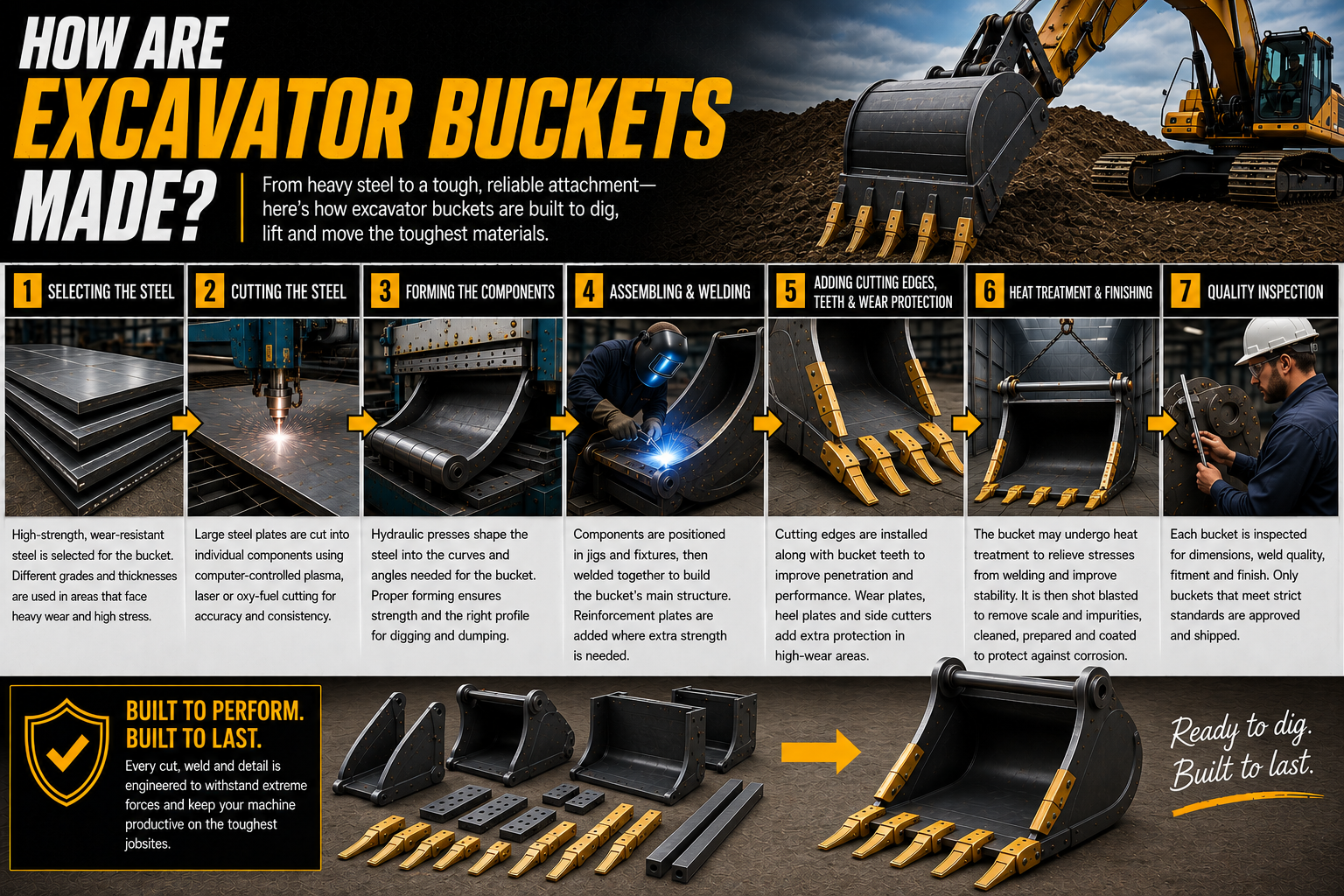
How Are Excavator Buckets Made?
An excavator bucket takes a serious beating on the jobsite. It digs through hard-packed soil, pries through rock, moves heavy material and repeatedly impacts the ground. Every part of the bucket must be built to withstand those demanding conditions while maintaining the strength and shape needed to get the job done.
So, what goes into making an excavator bucket tough enough for the job?
Let's take a closer look at the manufacturing process.
Step 1: Selecting the Steel
The manufacturing process begins with selecting the steel needed to build the bucket.
Excavator buckets commonly use high-strength and wear-resistant steels in areas exposed to heavy loads and abrasion. Different sections of the bucket may use different grades or thicknesses of steel depending on the forces and conditions they will encounter.
Materials may include:
• Structural steel plate
• High-strength steel
• Abrasion-resistant steel
• Wear-resistant plate
• Hardened components
Choosing the appropriate materials is critical. The bucket needs enough strength to resist bending and cracking while also providing the durability needed to withstand repeated contact with soil, rock and other abrasive materials.
Step 2: Cutting the Steel
Once the steel has been selected, large plates are cut into the individual components needed to build the bucket.
Computer-controlled cutting equipment can produce precise shapes from large sheets of steel. Depending on the manufacturer and material, processes such as plasma, laser or oxy-fuel cutting may be used.
The cutting process creates components such as:
• Side plates
• Bottom plates
• Back plates
• Top plates
• Mounting plates
• Cutting edges
• Reinforcement pieces
• Wear strips
Precise cutting is important because the individual pieces must fit together accurately during assembly.
Step 3: Forming the Bucket Components
Many of the steel components must be bent or formed before they can be assembled.
Large hydraulic presses apply tremendous force to shape steel plates into the curves and angles required by the bucket.
The bucket's profile affects how it enters the ground, collects material and releases its load. Manufacturers carefully control the forming process to achieve the required dimensions while avoiding damage to the steel.
Once formed, components can be checked to make sure they meet the required specifications before moving on to assembly.
Step 4: Assembling and Welding
After the steel pieces have been cut and formed, they're positioned together to create the bucket's main structure.
Fixtures and jigs may be used to hold components in the proper position during assembly. This helps maintain accurate dimensions and alignment.
The major components are then welded together, joining the side plates, bottom, back and other structural pieces into a single assembly.
Reinforcement plates and wear strips may also be welded onto areas that experience particularly high loads or abrasion.
Because excavator buckets are subjected to significant forces during digging, weld quality is critical. Manufacturers carefully control welding procedures to create strong, consistent joints throughout the bucket.
Step 5: Adding Cutting Edges, Teeth and Wear Protection
With the main bucket structure assembled, manufacturers install the components that engage with the material being excavated.
The cutting edge forms the leading edge of the bucket and helps it penetrate the ground. Bucket teeth are installed along the cutting edge to concentrate digging force and improve penetration into hard or compacted material.
Bucket teeth are installed along the cutting edge to concentrate digging force and improve penetration into hard or compacted material. Tooth adapters are typically attached to the bucket's cutting edge, while replaceable teeth fit onto the adapters and can be removed when they become worn.
Different tooth and adapter systems are available depending on the bucket and its intended application.
Manufacturers may also add additional protection to areas that experience heavy wear, including:
• Wear strips
• Wear plates
• Heel plates
• Side cutters
• Reinforcement ribs
• Internal wear protection
These components may be welded or mechanically attached, depending on their location and purpose.
Heavy-duty and rock buckets generally require more reinforcement and wear protection than buckets designed for general digging.
Step 6: Finishing, Heat Treatment and Surface Preparation
Once fabrication is complete, the bucket may undergo heat treatment to help relieve residual stresses created during welding.
For buckets that require post-weld heat treatment, the completed welded structure is placed inside a large industrial furnace and heated to a controlled temperature before being cooled according to the required process. This can help improve the stability of the finished structure and reduce stresses within the steel.
After heat treatment, the bucket goes through finishing operations. Welds may be cleaned and inspected, while sharp edges, excess material and surface imperfections are removed. The bucket may also undergo abrasive blasting using specialized equipment to remove mill scale, rust and other contaminants and prepare the steel for its protective coating.
Once the surface has been properly prepared, the bucket can be primed and painted or given another protective finish. The coating helps protect the steel from corrosion during storage and service.
Step 7: Quality Inspection
Before an excavator bucket leaves the factory, it undergoes a final quality inspection.
Inspectors may check:
• Overall dimensions
• Weld quality
• Mounting points
• Pin and bushing locations
• Cutting-edge alignment
• Tooth and adapter installation
• Reinforcement placement
• Surface finish
• Paint or coating quality
Depending on the manufacturer and bucket type, welds may also undergo nondestructive testing to identify defects that aren't visible during a standard visual inspection.
The finished bucket must meet the required specifications and be properly matched to the excavator it's designed to fit.
Built to Dig
An excavator bucket may begin as sheets of steel, but turning those materials into a dependable attachment requires precision manufacturing and careful attention to detail.
From cutting and forming the steel to welding the structure and installing wear components, every stage contributes to the bucket's ability to withstand the demands of excavation.
The next time an excavator digs into hard-packed soil, breaks through rock or moves a heavy load, take a closer look at the bucket. That rugged attachment is the result of a manufacturing process designed to keep it working through tough conditions, job after job.