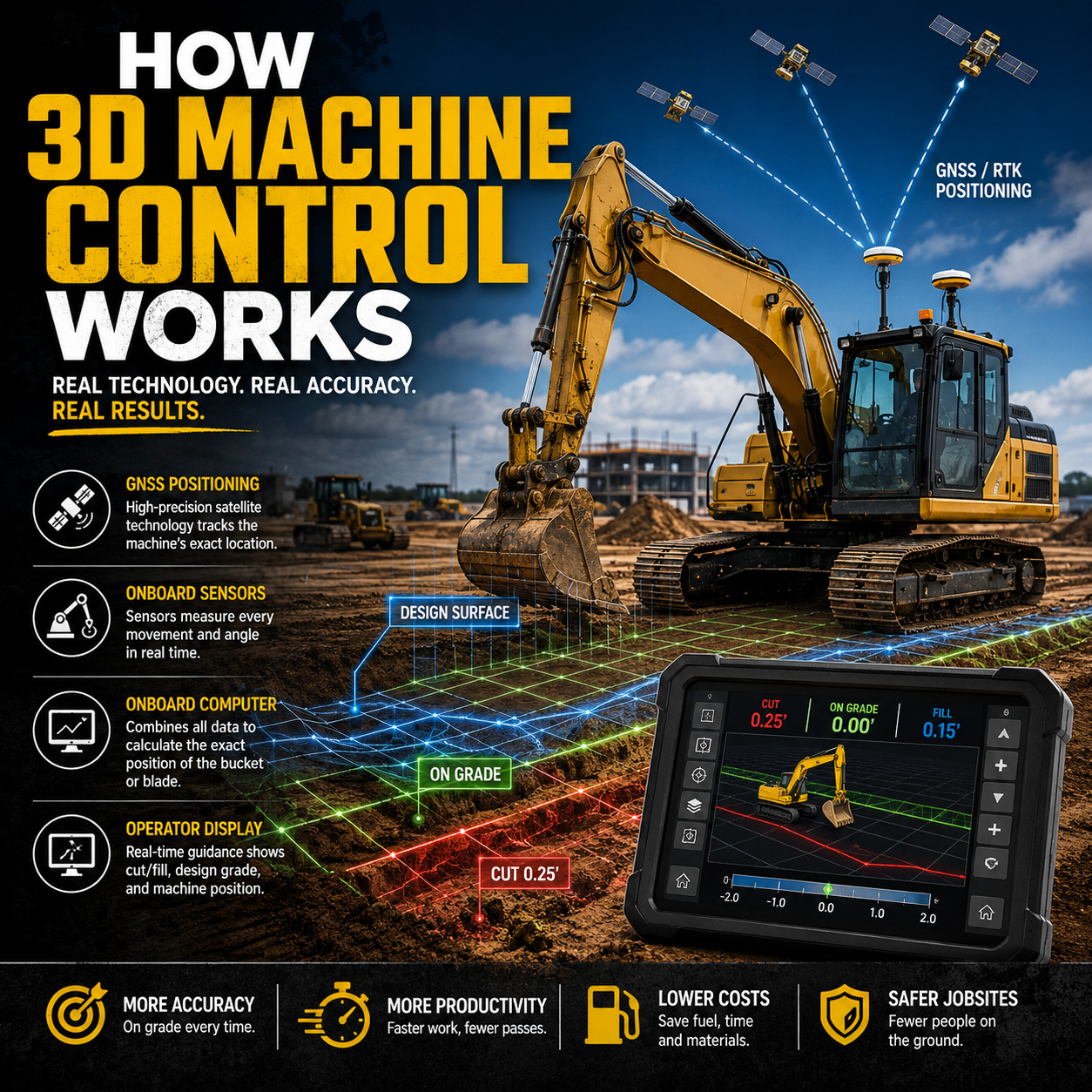
How 3D Machine Control Works
Construction has always been about precision. Every bucket of dirt moved, every grade established, and every trench excavated must meet exact specifications. In the past, achieving that accuracy relied heavily on survey stakes, string lines, grade checkers, and years of operator experience. Today, technology has transformed the process.
3D machine control systems allow heavy equipment operators to dig, grade, and shape the ground with incredible accuracy by using satellites, sensors, and digital construction models. The result is faster projects, less rework, lower fuel consumption, and improved productivity.
Here's a closer look at how 3D machine control works and why it's becoming standard equipment on construction sites around the world.
What Is 3D Machine Control?
3D machine control is a guidance system installed on heavy equipment that continuously compares the machine's position to a digital site plan. Instead of relying solely on grade stakes or manual measurements, the operator sees exactly where the machine is relative to the finished design in real time.
The system constantly answers questions like:
- How deep should I dig?
- Am I on the correct slope?
- Is this surface at finished grade?
- How much material still needs to be removed?
Think of it as a GPS navigation system—but instead of guiding a car down a highway, it guides an excavator bucket or dozer blade to within a few centimeters of the target elevation.
The Main Components
A complete 3D machine control system consists of several technologies working together.
GNSS (GPS) Receivers
Most systems use two GNSS receivers mounted on top of the machine.
These receivers communicate with multiple satellite constellations, including:
- GPS
- GLONASS
- Galileo
- BeiDou
Using signals from several satellite systems increases accuracy and reliability.
Inertial Sensors
Sensors placed throughout the machine measure:
- Boom angle
- Stick position
- Bucket angle
- Blade height
- Machine pitch
- Machine roll
Every movement of the machine is tracked hundreds of times per second.
Angle Sensors
Rotary sensors measure the exact position of each hydraulic joint.
The onboard computer knows precisely where every component is located in three-dimensional space.
Onboard Computer
The computer processes information from:
- Satellite positioning
- Machine sensors
- Hydraulic geometry
- Digital terrain models
It continuously calculates where the cutting edge or bucket teeth are located.
Operator Display
Inside the cab is a touchscreen monitor showing:
- Current machine position
- Design grade
- Cut/fill values
- Cross sections
- Site maps
- Finished surface
The operator receives real-time visual guidance while working.
How the System Knows Where the Bucket Is
This is where the technology becomes impressive.
The GPS receivers know the location of the machine.
The sensors know:
- How high the boom is
- How far the stick extends
- The angle of the bucket
The computer combines all these measurements to calculate the exact position of the bucket teeth—even though the GPS antennas are mounted on top of the cab.
This calculation updates many times every second.
Digital Site Models
Before work begins, engineers create a digital terrain model (DTM).
The model includes:
- Finished grades
- Slopes
- Curbs
- Roads
- Drainage
- Building pads
- Utilities
- Elevations
The file is loaded into the machine.
Instead of following wooden stakes placed every few feet, the operator follows the complete digital design.
Real-Time Kinematic (RTK) Correction
Standard GPS can be accurate within several feet—not nearly precise enough for construction.
3D machine control typically uses RTK correction.
An RTK base station sits on the jobsite or receives correction data from a network.
This improves positioning accuracy to approximately:
- 1–3 cm (0.4–1.2 inches)
That level of precision makes finish grading possible without repeated surveying.
Cut and Fill Guidance
One of the most useful features is cut/fill guidance.
The display tells the operator:
- Cut 8 inches
- Raise blade 2 inches
- On grade
- Fill 5 inches
Instead of constantly stopping for measurements, operators receive continuous feedback while moving.
Automatic Blade Control
Many modern bulldozers include automatic blade control.
Instead of manually adjusting the blade height, the hydraulic system automatically raises or lowers it to maintain the design grade.
The operator simply focuses on steering.
Benefits include:
- Better finish quality
- Fewer passes
- Reduced operator fatigue
- Less material waste
Excavator Guidance
Excavators use machine control differently.
Rather than automatically moving the boom, most systems guide the operator by displaying:
- Bucket depth
- Bucket slope
- Trench alignment
- Swing angle
- Utility locations
Some advanced systems can assist with semi-automatic boom or bucket movements while keeping the operator in control.
Benefits of 3D Machine Control
Less Rework
Mistakes become much less common when operators always know their exact position.
That means:
- Fewer over-excavations
- Less backfilling
- Reduced correction work
Faster Production
Operators spend less time:
- Waiting for surveyors
- Checking grade
- Measuring elevations
- Repositioning equipment
Projects move faster from start to finish.
Fuel Savings
Every unnecessary pass burns fuel.
Accurate grading often requires fewer machine movements, reducing fuel consumption and engine hours.
Material Savings
Overcutting wastes:
- Aggregate
- Asphalt
- Concrete
- Fill dirt
Accurate excavation reduces material costs across the project.
Better Safety
With fewer survey stakes and grade checkers working near active equipment, there are fewer people exposed to moving machinery.
Many systems also display underground utilities and exclusion zones, helping operators avoid hazards.
Can New Operators Benefit?
Absolutely.
Experienced operators still bring valuable judgment and machine control skills, but 3D guidance helps newer operators achieve accurate results more quickly.
Rather than replacing operator skill, the technology enhances it by providing constant feedback.
Industries Using 3D Machine Control
The technology is now common in:
- Highway construction
- Residential developments
- Commercial building sites
- Mining
- Landfills
- Airports
- Rail construction
- Pipeline projects
- Wind farms
- Solar farms
As projects become more complex, digital guidance is becoming an expected part of modern equipment fleets.
Is It Worth the Investment?
A complete 3D machine control system represents a significant investment, but many contractors recover the cost through improved efficiency.
Potential savings come from:
- Reduced survey work
- Faster completion times
- Lower fuel usage
- Less material waste
- Fewer costly grading errors
- Increased machine productivity
For contractors managing large earthmoving or grading projects, the return on investment can be substantial over the life of the equipment.
The Future of Machine Control
Today's 3D systems are only the beginning. New developments are bringing cloud-connected jobsite data, remote design updates, fleet-wide machine coordination, and AI-assisted workflows that help operators make informed decisions in real time.
As construction becomes increasingly digital, machine control systems will continue to play a central role in improving accuracy, productivity, and efficiency.
Indispensable Tool
3D machine control has fundamentally changed the way earthmoving and grading projects are completed. By combining satellite positioning, onboard sensors, digital design models, and real-time computing, these systems help operators achieve precise results with fewer passes and less guesswork.
Whether it's a bulldozer shaping a roadbed, an excavator digging a utility trench, or a motor grader finishing a highway, 3D machine control is helping contractors deliver projects faster, more accurately, and more efficiently than ever before. As the technology continues to evolve, it is likely to become an indispensable tool on construction sites of every size.