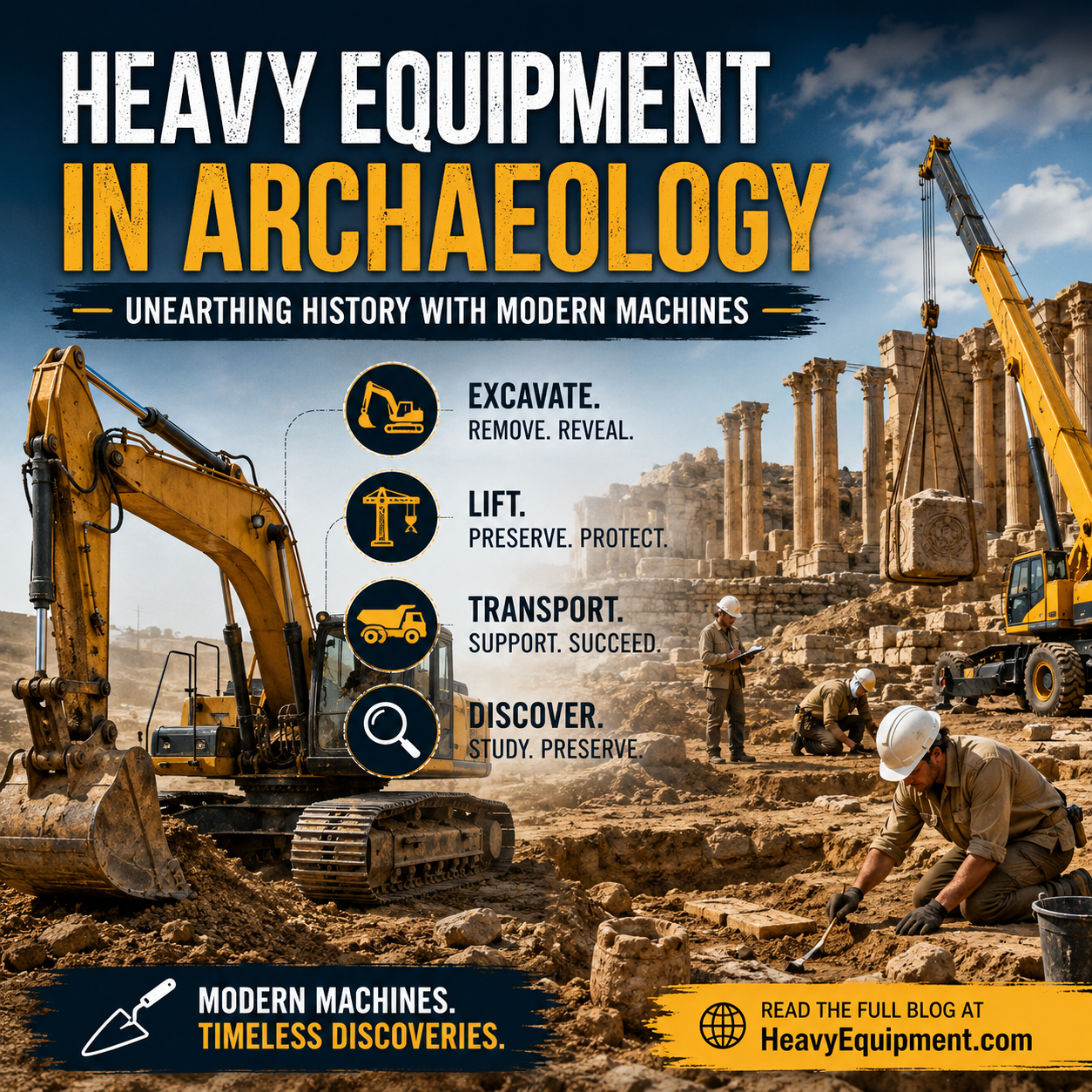
Heavy Equipment Used in Archaeology: Unearthing History with Modern Machines
When most people picture an archaeological dig, they imagine researchers carefully brushing dirt away from ancient pottery or delicately uncovering dinosaur fossils with hand tools. While precision work is certainly a critical part of archaeology, many excavations begin with something much larger: heavy equipment.
From excavators removing layers of modern debris to cranes lifting priceless artifacts weighing several tons, heavy machinery has become an indispensable part of archaeological projects around the world. The key is knowing when to use machines—and when to put them aside in favor of hand tools.
Here's a look at how heavy equipment helps archaeologists uncover the past without destroying it.
Why Archaeologists Use Heavy Equipment
Archaeology isn't simply about digging holes. Before researchers can begin studying ancient remains, they often need to remove:
- Modern construction materials
- Asphalt and concrete
- Topsoil deposited over centuries
- Rubble from previous buildings
- Landslide or flood debris
On large sites, doing this work entirely by hand could take months or even years. Heavy equipment dramatically reduces excavation time while allowing archaeologists to focus their efforts on historically significant layers.
The goal is efficiency without sacrificing preservation.
Excavators: The Most Common Machine on Site
Excavators are perhaps the most recognizable machines used during archaeological excavations.
Rather than digging deep trenches quickly as they would on a construction site, archaeological operators work slowly and deliberately, often removing soil only a few inches at a time.
Special precautions include:
- Flat-bottom grading buckets instead of toothed buckets
- Small, controlled movements
- Continuous supervision by archaeologists
- Immediate stopping when artifacts or structural remains appear
Experienced operators become an extension of the archaeological team, removing only material that researchers have identified as safe to excavate mechanically.
Bulldozers for Site Preparation
Bulldozers aren't typically used near sensitive archaeological remains, but they play an important supporting role.
Common uses include:
- Clearing vegetation
- Building temporary access roads
- Removing modern fill
- Creating safe work areas
- Stabilizing excavation sites
Once archaeologists approach layers that may contain artifacts, bulldozers are usually replaced with more precise equipment.
Wheel Loaders Handle Material Efficiently
Large excavation projects generate enormous amounts of soil.
Wheel loaders move excavated material to stockpiles where archaeologists can later screen it for smaller artifacts.
They're also useful for:
- Loading dump trucks
- Moving gravel
- Transporting excavation materials
- Maintaining access roads
Their versatility makes them valuable throughout long-term excavations.
Backhoes for Smaller Projects
Many archaeological investigations occur ahead of road construction, utility installation, or building projects.
For these smaller jobs, backhoe loaders are often the ideal machine because they combine excavation capability with loader functionality.
Backhoes allow crews to:
- Dig test trenches
- Expose soil layers
- Backfill completed excavations
- Move supplies around the site
Their compact size makes them particularly useful in urban archaeology.
Cranes Lift Massive Historical Artifacts
Some discoveries simply can't be moved by hand.
Archaeological cranes have lifted:
- Ancient statues
- Stone columns
- Temple blocks
- Sarcophagi
- Shipwreck components
- Giant fossil specimens
Every lift requires extensive engineering calculations to avoid damaging priceless historical objects that may be thousands of years old.
In some cases, custom lifting frames are built specifically for a single artifact.
Telehandlers and Forklifts Keep Projects Moving
Excavation sites often function like small construction projects.
Telehandlers and forklifts transport:
- Protective shelters
- Scientific equipment
- Pallets of supplies
- Conservation materials
- Water tanks
- Temporary fencing
Because archaeological digs may continue for months or years, efficient logistics become essential.
Dump Trucks Remove Excavated Soil
Large archaeological projects can produce tens of thousands of cubic yards of excavated material.
Dump trucks transport excess soil while keeping excavation areas organized and safe.
On many projects, excavated material is never truly discarded. Instead, it's stored nearby until archaeologists confirm that every layer has been properly documented.
Compact Equipment Reduces Ground Disturbance
Mini excavators and compact track loaders have become increasingly popular on archaeological sites because they minimize surface disturbance.
Benefits include:
- Lower ground pressure
- Better maneuverability
- Greater visibility
- Reduced risk around fragile structures
- Easier transport between excavation areas
These machines are especially useful at historic sites with limited access.
GPS and Laser Technology Improve Accuracy
Modern archaeological excavations increasingly combine heavy equipment with advanced surveying technology.
GPS-guided equipment allows operators to:
- Remove precise soil depths
- Stay within designated excavation boundaries
- Avoid sensitive areas
- Create accurate digital site models
Laser scanning and drone mapping further improve documentation before, during, and after excavation.
This technology helps preserve valuable information even after soil has been removed.
Famous Discoveries That Relied on Heavy Equipment
Many of history's most important archaeological discoveries involved machinery during at least part of the excavation process.
Examples include:
The Terracotta Army (China)
Heavy equipment helped remove overburden and prepare excavation areas before archaeologists began the painstaking work of uncovering thousands of life-sized clay soldiers by hand.
Egyptian Temples
Modern excavations around ancient temples often rely on cranes and excavators to remove collapsed stone blocks while preserving surrounding structures.
Viking Ship Excavations
Large cranes have lifted fragile ship remains using specially designed support structures to prevent damage.
Dinosaur Fossil Sites
Although technically paleontology rather than archaeology, excavators frequently remove massive amounts of rock and sediment before fossil preparation begins by hand.
The Importance of Skilled Operators
Running heavy equipment on an archaeological site requires a very different mindset than conventional construction.
Operators must:
- Work slowly
- Follow archaeological direction
- Recognize changes in soil color
- Stop immediately when unusual materials appear
- Understand the importance of preserving context
Many experienced operators develop excellent instincts for recognizing features that could indicate buried structures or artifacts.
The best equipment operators become trusted members of archaeological teams.
When Machines Must Stop
Eventually, every excavation reaches a point where heavy equipment is no longer appropriate.
At that stage, archaeologists switch to:
- Trowels
- Brushes
- Dental picks
- Sieves
- Measuring tools
- Photography equipment
- 3D scanning technology
The final stages of excavation often proceed one centimeter at a time.
While heavy machinery uncovers the broader picture, the smallest tools reveal the details that help researchers understand how ancient people lived.
Essential Partners
Heavy equipment and archaeology may seem like an unlikely combination, but modern excavation depends on both. Machines remove the obstacles that stand between researchers and the past, while skilled archaeologists ensure that history is preserved rather than destroyed.
From excavators carefully peeling away layers of soil to cranes lifting monumental artifacts, heavy machinery has become an essential partner in uncovering civilizations, protecting cultural heritage, and expanding our understanding of human history.
Without today's equipment operators working alongside archaeologists, many of the world's greatest discoveries might still be buried beneath our feet.