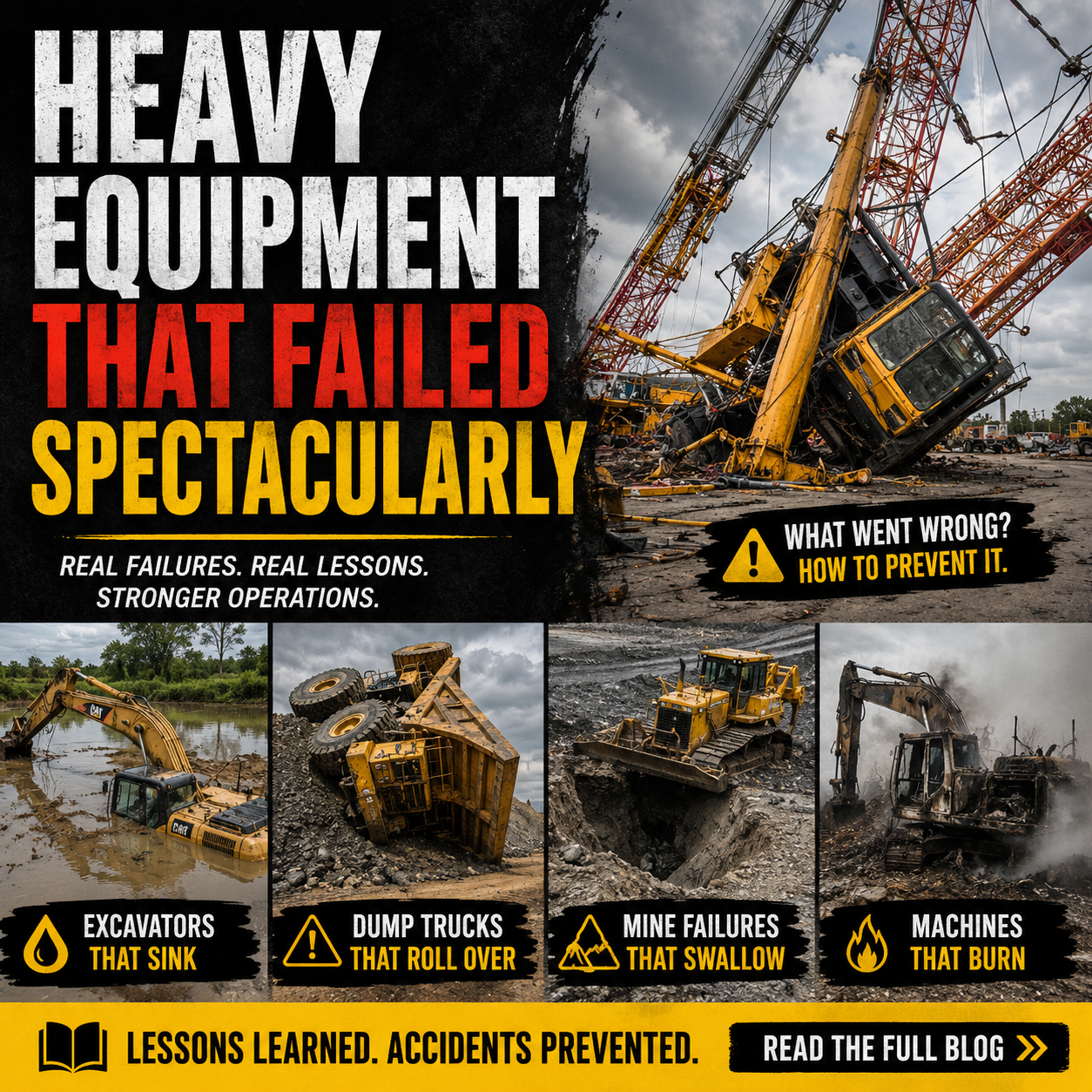
Heavy Equipment That Failed Spectacularly (And Why)
Heavy equipment is built to withstand brutal conditions. Massive loads, rough terrain, extreme temperatures, and thousands of hours of operation are all part of the job. But every so often, a machine fails in a way that's so dramatic it becomes a lesson for the entire industry.
From collapsing cranes to sinking excavators and bulldozers swallowed by the earth, these failures are rarely caused by bad luck alone. Nearly every catastrophic incident can be traced back to overlooked engineering limits, improper planning, poor maintenance, or simple human error.
Here are some of the most spectacular types of heavy equipment failures—and the valuable lessons they continue to teach.
Crane Collapses
Tower cranes and mobile cranes are engineering marvels capable of lifting hundreds of tons with remarkable precision. But they're also among the most unforgiving machines when their limits are exceeded.
Some of the most dramatic crane failures have occurred because:
- Outriggers weren't properly supported.
- The crane exceeded its rated load.
- Wind speeds were ignored.
- Ground conditions weren't properly evaluated.
- Improper assembly or disassembly procedures were followed.
A crane's lifting chart isn't a suggestion—it's the product of extensive engineering calculations. Even a seemingly small overload can dramatically change the machine's center of gravity, causing a tip-over that happens in seconds.
Lesson learned: Ground preparation and lift planning are just as important as the crane itself.
Excavators That Sink
Almost every experienced operator has seen photos—or videos—of excavators disappearing into rivers, ponds, or muddy construction sites.
The causes are often surprisingly simple:
- Soft, unstable soil.
- Hidden underground voids.
- Operating too close to embankments.
- Saturated ground after heavy rain.
Excavators exert enormous ground pressure despite their tracks spreading the load. Once the soil can no longer support the machine's weight, recovery quickly becomes complicated and expensive.
In many cases, recovering the machine costs more than repairing the damage.
Lesson learned: Never assume the ground beneath your tracks is as solid as it looks.
Bulldozers Swallowed by Mine Failures
Mining operations push heavy equipment harder than almost any other industry.
There have been incidents where entire dozers have disappeared into collapsing spoil piles or unstable highwalls.
Common contributing factors include:
- Poor geotechnical assessment.
- Undercut slopes.
- Excessive vibration.
- Water infiltration weakening the ground.
Mine operators now rely heavily on slope monitoring systems, GPS technology, and geotechnical engineers to detect movement before disaster strikes.
Lesson learned: Earth doesn't always fail gradually—it can fail instantly.
Dump Trucks That Rolled Over
Rigid-frame haul trucks can weigh over one million pounds when fully loaded.
Despite their enormous size, they're surprisingly vulnerable to rollovers.
Frequent causes include:
- Uneven loading.
- Excessive speed on haul roads.
- Soft road shoulders.
- Sharp cornering.
- Tire failures.
A high center of gravity combined with shifting material can quickly overcome even sophisticated suspension systems.
Modern mines invest heavily in haul-road maintenance because road quality directly affects truck safety.
Lesson learned: Good roads are just as important as good trucks.
Hydraulic Failures Under Pressure
Hydraulic systems make modern heavy equipment possible.
But when hydraulic components fail, the results can be sudden and violent.
Potential failures include:
- Burst hoses.
- Cylinder seal failures.
- Pump failures.
- Contaminated hydraulic oil.
- Improper hose routing.
A failed hydraulic line can instantly remove lifting capability or allow attachments to fall unexpectedly.
Routine oil analysis and preventative hose replacement have become standard practices because hydraulic failures often give warning signs before becoming catastrophic.
Lesson learned: Small hydraulic leaks are often the beginning—not the end—of the problem.
Machines That Burn to the Ground
Equipment fires remain one of the most expensive failures in the construction and mining industries.
Common ignition sources include:
- Hydraulic oil leaks.
- Fuel leaks.
- Electrical shorts.
- Turbochargers reaching extreme temperatures.
- Accumulated debris around the engine compartment.
Fine wood chips, leaves, grease, and oil create ideal fuel for engine fires.
Many operators now perform daily engine compartment cleanouts specifically to reduce fire risk.
Lesson learned: Clean machines are safer machines.
Bridge Strikes
Sometimes the machine itself isn't the problem.
Transporting oversized equipment has led to countless bridge strikes caused by:
- Incorrect height measurements.
- Route planning errors.
- Suspension changes during transport.
- Improper loading.
A bridge strike can destroy expensive equipment, damage public infrastructure, and create major traffic disruptions.
Professional heavy-haul companies spend significant time planning routes to avoid these costly mistakes.
Lesson learned: The trip to the jobsite can be as risky as the job itself.
Bucket and Boom Failures
Attachments experience incredible stress over thousands of operating hours.
Eventually, fatigue can lead to:
- Cracked booms.
- Broken bucket ears.
- Failed welds.
- Bent linkage components.
Unlike overload failures, fatigue develops slowly through repeated stress cycles.
Small cracks often grow for months before finally causing a dramatic structural failure.
Routine inspections frequently catch these cracks early enough for repairs before catastrophic damage occurs.
Lesson learned: Tiny cracks rarely stay tiny.
When Technology Fails
Modern heavy equipment depends on electronics as much as hydraulics.
GPS machine control, sensors, cameras, control modules, and onboard computers have dramatically improved productivity.
However, electronic failures can also disable machines without any mechanical damage.
Common issues include:
- Damaged wiring harnesses.
- Sensor failures.
- Software errors.
- Water intrusion.
- Voltage problems.
Fortunately, modern diagnostic systems often identify electronic faults much faster than older machines.
Lesson learned: Today's toolbox includes both wrenches and laptops.
Why Most Catastrophic Failures Are Preventable
The most important takeaway from nearly every spectacular equipment failure is this:
Very few happen without warning.
There are usually signs beforehand:
- Unusual noises.
- Minor leaks.
- Ground movement.
- Cracked welds.
- Load chart violations.
- Deferred maintenance.
- Ignored inspections.
Catastrophic failures often result from multiple small problems lining up rather than one single event.
That's why experienced operators perform walk-around inspections every day. Those few extra minutes can prevent repairs costing hundreds of thousands—or even millions—of dollars.
Respect the Limits
Heavy equipment is among the toughest machinery ever built, but even the strongest machines have limits. Respecting those limits is what separates reliable operations from spectacular failures.
Every collapsed crane, overturned haul truck, burned excavator, or cracked boom tells a story. While the photos may be dramatic, the real value lies in understanding why the failure happened and applying those lessons to future jobs.
For heavy equipment operators, mechanics, fleet managers, and enthusiasts alike, studying these failures isn't about pointing fingers—it's about appreciating the engineering behind these incredible machines and ensuring they continue working safely for years to come.