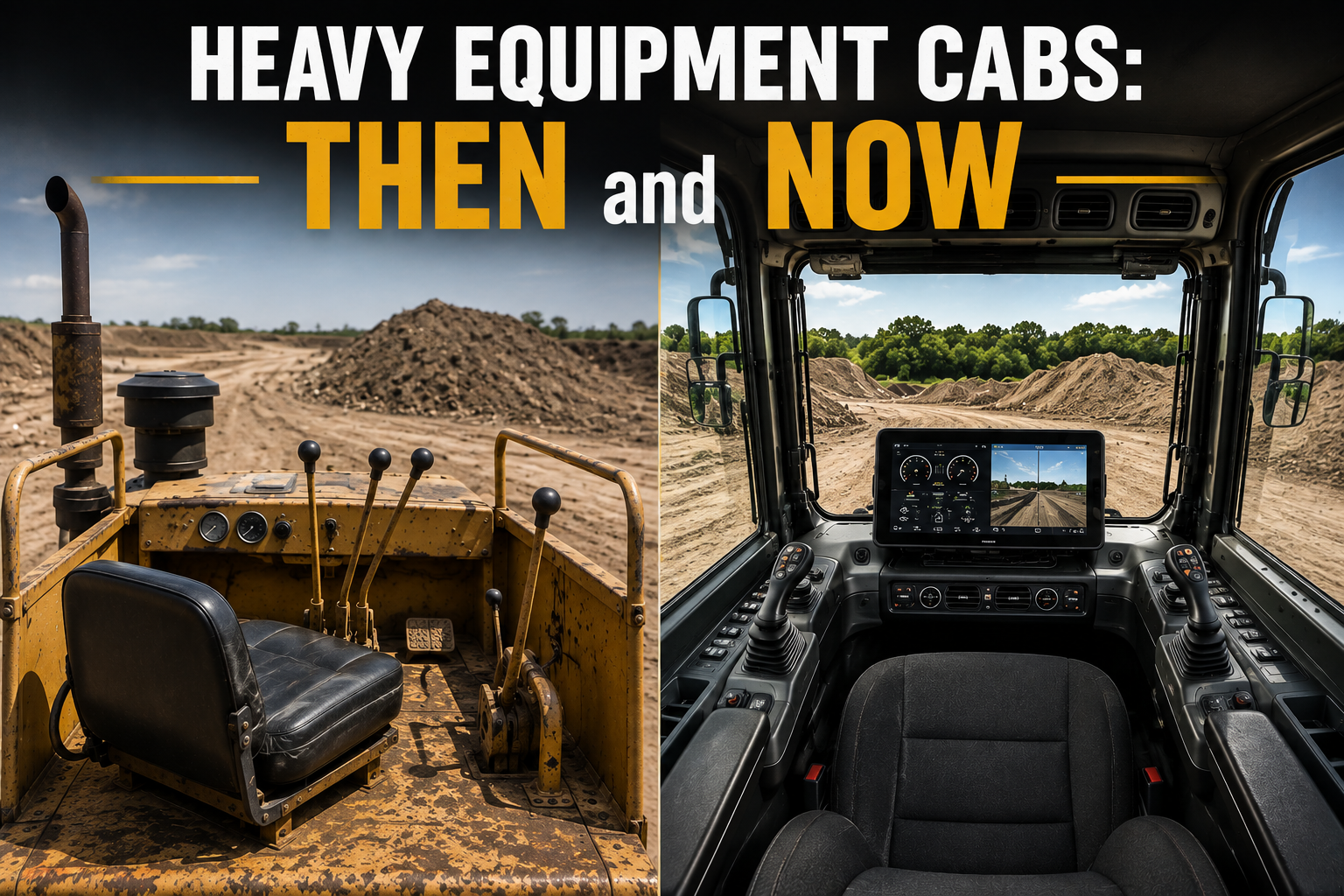
Heavy Equipment Cabs: Then and Now
For much of heavy equipment’s history, the operator’s station was a relatively simple place to control the machine. A seat, a collection of levers and pedals, and a few gauges were often all the operator had to work with.
Today, the cab has become one of the most sophisticated parts of a heavy machine. Modern cabs combine operator protection, comfort, visibility, electronic controls, digital displays and machine technology in an environment designed around the person operating the equipment.
Then: The Open Operator Station
Older heavy equipment often featured open operator stations that left the operator exposed to the weather, dust, noise and other conditions on the jobsite.
Controls were generally mechanical, with levers and pedals connected directly to the machine's operating systems. The operator's seat typically offered limited adjustment, while instrumentation consisted of basic analog gauges.
There was also considerably less information available to the operator. Machine performance, fluid levels and potential problems often had to be monitored through gauges, inspections and experience.
That doesn't mean older machines were ineffective. They were designed for the technology available at the time, and skilled operators could accomplish a tremendous amount with relatively simple equipment.
Enclosed Cabs Change the Operator Environment
As equipment evolved, enclosed cabs became increasingly common.
Closing off the operator's station provided protection from weather, dust and jobsite debris while also creating an environment where heating and air conditioning could be added. Improved insulation helped reduce noise, making the cab a more comfortable place to spend a full workday.
Protective structures also became an important part of cab design. Rollover protective structures and falling-object protection help provide operators with greater safety in hazardous conditions.
From Levers to Joysticks
One of the most noticeable changes is the way operators control machines.
Older equipment commonly relied on mechanical levers and pedals. Modern equipment increasingly uses pilot controls, electrohydraulic systems and multifunction joysticks.
Instead of reaching for several large mechanical levers, operators can perform many functions from controls positioned close to their hands. This can make machine operation more intuitive while reducing the physical effort required for some tasks.
Seats Become Part of the Technology
The operator's seat has also changed significantly.
A basic fixed seat has given way to adjustable suspension seats designed to provide greater support and reduce vibration. Modern seats can include adjustable armrests, headrests and other features that allow operators to configure the workspace around their needs.
That matters because operators can spend many hours inside a machine during a typical workday. A more comfortable and ergonomic environment can help reduce fatigue and make it easier to remain focused.
The Dashboard Moves into the Digital Age
Older machines provided information through individual gauges.
Modern equipment can put a much larger amount of information directly in front of the operator through digital displays and touchscreen monitors. Depending on the machine, operators may be able to view engine information, hydraulic settings, fuel levels, camera feeds, operating modes and diagnostic alerts.
The cab has effectively become an information center for the machine.
Visibility Gets a Technology Boost
The operator's ability to see the jobsite has evolved as well.
Larger windows and redesigned cab structures can improve sightlines, while rearview and surround-view cameras can provide views that would otherwise be difficult or impossible for the operator to see.
Some newer systems go even further with object detection and other technologies designed to help operators identify potential hazards around the machine.
Technology doesn't replace the operator's awareness, but it can give the operator more information to work with.
From Experience to Machine Guidance
Operators have always relied on experience to position machines accurately. Stakes, grade references and visual measurements were once essential parts of many earthmoving operations.
Today, GPS/GNSS and 3D machine-control systems can provide operators with digital information about the machine's position and the desired grade or design.
That can help operators work more precisely while reducing reliance on some traditional grade-checking methods.
The Cab Becomes a Connected Workspace
Modern equipment can also communicate information beyond the cab.
Telematics systems can collect information about machine location, operating hours, fuel use, maintenance needs and machine health. In some cases, diagnostic information can be accessed remotely by fleet managers or service personnel.
As a result, the cab is no longer isolated from the rest of the operation. The machine can be part of a connected fleet that provides information to people both on and off the jobsite.
Now: A Workplace Built Around the Operator
Today's heavy equipment cab is much more than a place to sit and operate a machine.
It can combine climate control, ergonomic seating, electronic controls, digital displays, cameras, machine guidance and connectivity into a single workspace.
The transformation reflects a broader change in equipment design. Manufacturers aren't just building machines to move more material or dig deeper. They are also designing the operator environment to improve comfort, visibility, safety, control and productivity.
From open-air stations with mechanical levers to enclosed, technology-filled cabs, the operator's workspace has come a long way.
And as automation, connectivity and machine-control technology continue to develop, the cab will likely become an even more important part of the heavy equipment experience.