Equipment That Keeps Antarctica Running: The Machines That Power Life at the Bottom of the World
When most people think of Antarctica, they picture endless snow, towering glaciers, penguins, and some of the harshest weather on Earth. What they don't often think about is the remarkable fleet of heavy equipment that makes scientific research—and human survival—possible on the frozen continent.
With no permanent cities, no public roads, and winter temperatures that can plunge below -80°C (-112°F), Antarctica is one of the most demanding environments any machine will ever face. Every piece of equipment operating there must withstand extreme cold, hurricane-force winds, blowing snow, and months of darkness.
Without these specialized machines, research stations couldn't be built, supplies couldn't be delivered, and groundbreaking scientific discoveries simply wouldn't happen.
Building Civilization in the Coldest Place on Earth
There are more than 70 research stations scattered across Antarctica, operated by dozens of countries. While they range from small seasonal camps to year-round facilities housing hundreds of researchers, they all rely on heavy equipment.
Everything—from constructing buildings to maintaining airstrips—requires machinery specifically adapted for polar conditions.
Unlike a construction site in North America or Europe, Antarctica has no local equipment dealer, no overnight parts delivery, and no nearby repair shop. Reliability isn't just convenient—it's essential.
Snow Groomers: Antarctica's Road Builders
One of the most recognizable machines on the continent is the snow groomer.
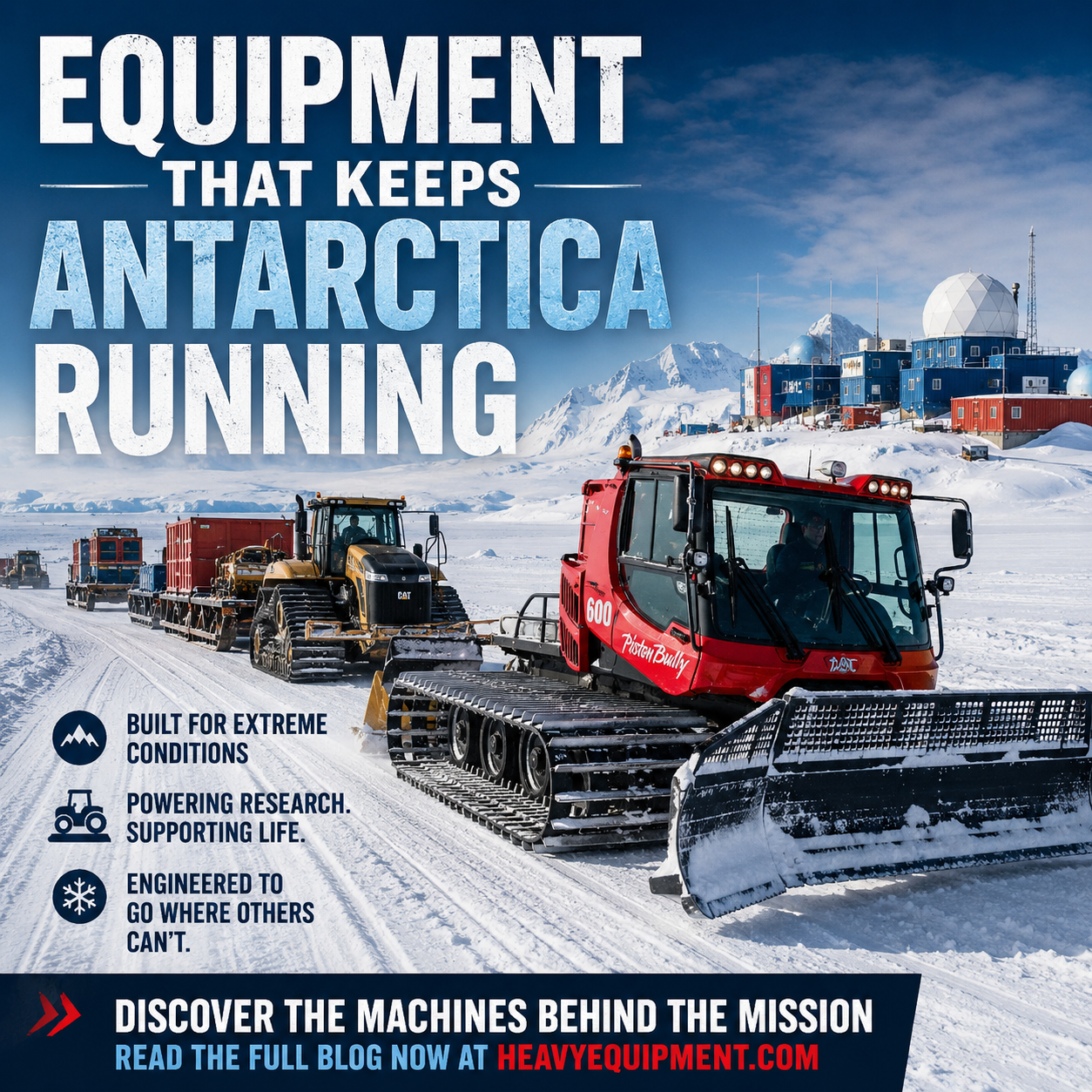
Machines like the PistenBully and Prinoth are used far beyond ski resorts. In Antarctica they:
- Build snow roads between research stations
- Prepare aircraft landing strips
- Compact snow for cargo operations
- Pull heavy sled trains carrying fuel and supplies
- Clear accumulated drifts around buildings
Many stations rely on hundreds of kilometers of groomed snow routes that must be maintained throughout the year.
Tracked Tractors Pull Entire Supply Trains
Perhaps the most impressive equipment operating in Antarctica are massive tracked tractors pulling enormous sled convoys.
Instead of using wheeled trucks, research programs often transport supplies using:
- Caterpillar tracked tractors
- Challenger agricultural tractors fitted for polar service
- Specialized tracked prime movers
These machines haul sled trains weighing hundreds of tons across hundreds of kilometers of ice.
Fuel, food, scientific equipment, construction materials—even entire buildings—can be transported this way.
The sled trains are often more fuel-efficient than repeated aircraft flights and can operate where roads simply don't exist.
Excavators That Dig Ice Instead of Dirt
Excavators still have an important role.
Rather than digging soil, they may be used to:
- Excavate packed snow
- Remove accumulated drifts
- Prepare foundations for temporary structures
- Install underground utilities beneath insulated snow cover
- Assist in scientific drilling projects
Hydraulic systems require specially formulated low-temperature fluids that remain usable in extreme cold.
Bulldozers That Never See Dirt
Bulldozers are among Antarctica's hardest-working machines.
Their responsibilities include:
- Building snow roads
- Leveling construction areas
- Creating protective snow berms
- Maintaining runways
- Recovering stuck vehicles
Operators often work in whiteout conditions where visibility drops to only a few meters.
GPS guidance systems have become increasingly important because visual landmarks can disappear entirely.
Loaders Keep Stations Supplied
Wheel loaders and tracked loaders perform daily material handling tasks.
They unload:
- Shipping containers
- Fuel drums
- Pallets
- Scientific instruments
- Building supplies
Cold-weather modifications often include:
- Engine block heaters
- Heated hydraulic reservoirs
- Insulated engine compartments
- Arctic-grade lubricants
- Heated operator cabs
Without these upgrades, equipment might never start after sitting outside overnight.
Cranes Assemble Research Stations
Building in Antarctica isn't much different than construction anywhere else—except everything happens in freezing temperatures.
Mobile cranes are used to:
- Assemble prefabricated buildings
- Lift generators
- Install fuel tanks
- Position scientific equipment
- Load cargo ships
Because construction seasons are short, reliability and careful planning are critical.
Airfield Equipment Keeps Flights Moving
Aircraft are the lifeline of Antarctica.
Heavy equipment maintains runways made of compacted snow or blue ice by:
- Compacting surfaces
- Removing snow accumulation
- Grooming landing areas
- Marking runways
- Maintaining access roads
Some stations even operate giant snow blowers capable of clearing massive drifts after storms.
Specialized Vehicles Built for Polar Exploration
Some vehicles operating in Antarctica were designed specifically for polar travel.
These include:
- Enclosed tracked personnel carriers
- Oversized low-ground-pressure transporters
- Amphibious snow vehicles
- Ice drilling support vehicles
Their enormous tracks distribute weight over large areas, helping prevent the machines from sinking into soft snow.
Fuel: The Most Important Cargo
Nearly every machine in Antarctica runs on diesel fuel.
Keeping that fuel usable is a challenge.
Fuel systems often include:
- Heated storage tanks
- Fuel additives to prevent gelling
- Insulated transfer lines
- Water separation systems
- Continuous circulation pumps
A frozen fuel line can stop an entire operation.
Mechanics Face Incredible Challenges
Repairing heavy equipment in Antarctica requires creativity.
Mechanics can't simply order a replacement part overnight.
Instead they often:
- Fabricate components on-site
- Stock months' worth of spare parts
- Perform preventative maintenance aggressively
- Keep multiple backup machines available
- Repair equipment inside heated maintenance buildings whenever possible
Even changing engine oil becomes more difficult when temperatures can freeze exposed fluids almost immediately.
Environmental Protection Comes First
Operating heavy equipment in Antarctica comes with strict environmental responsibilities.
Equipment operators work carefully to minimize:
- Fuel spills
- Hydraulic leaks
- Waste generation
- Disturbance to wildlife
- Environmental contamination
Many stations use specially designed containment systems beneath parked equipment and fueling operations to help protect the fragile polar ecosystem.
Engineering Meets Endurance
The heavy equipment operating in Antarctica may never dig a subdivision, build a highway, or work a typical construction project.
Instead, these machines support climate research, astronomy, geology, biology, and countless scientific missions that help us better understand our planet.
Every mile traveled across the ice, every runway maintained, and every building erected depends on machines engineered to perform where almost nothing else can.
In one of Earth's most unforgiving environments, heavy equipment isn't just making work easier—it's making human presence possible.
For heavy equipment enthusiasts, Antarctica offers a fascinating reminder that the toughest jobs aren't always found in mines, forests, or construction sites. Sometimes, they're at the very bottom of the world, where every successful engine start is an engineering achievement in itself.