Could You Maintain a Rural Property for 30 Days Without Grid Power?
For many rural property owners, electricity is more than a convenience. It keeps water flowing, buildings heated, livestock cared for, and essential equipment operating. But what would happen if the power went out and didn't come back for an entire month?
A prolonged power outage could be caused by a severe winter storm, wildfire, damaged transmission infrastructure, equipment failure, or another event that leaves rural communities without reliable electricity. While urban residents might have relatively quick access to emergency services and supplies, people living on farms, acreages, and remote properties can face additional challenges.
Fortunately, rural properties often have something that urban households don't: access to tractors, diesel engines, generators, fuel storage, and mechanical equipment capable of performing essential work without relying entirely on the electrical grid.
The question isn't necessarily whether you could live without electricity for 30 days. It's whether you could keep your property functioning safely and effectively using the equipment and resources available to you.
Let's examine what that might involve.
Determining Which Property Operations Are Essential
Before starting a generator or bringing out the tractor, a property owner would need to identify which systems absolutely must continue operating.
Not every electrical appliance or piece of equipment is equally important during an extended outage.
For a typical rural property, essential operations might include:
• Water supply: Operating well pumps, pressure systems, and livestock watering equipment.
• Heating: Keeping occupied buildings warm and protecting plumbing from freezing.
• Food preservation: Maintaining refrigerators, freezers, and other temperature-sensitive storage.
• Livestock care: Providing water, feed, ventilation, and appropriate shelter.
• Property access: Keeping driveways, farm lanes, and emergency access routes clear.
• Communications: Charging phones, operating radios, and maintaining access to emergency information.
• Equipment maintenance: Keeping tractors, generators, and other critical machinery operational.
A property with livestock, multiple buildings, or a deep water well could require considerably more energy than a small acreage with a wood stove and gravity-fed water supply.
The first challenge would be separating essential electrical loads from everything that could temporarily be shut down.
For example, a 240-volt well pump might need a substantial amount of power when starting, but it may only operate intermittently. A freezer generally uses much less electricity, although it must remain cold enough to preserve its contents.
Understanding these differences would help determine how large a generator is necessary and how much fuel might be consumed over 30 days.
Could a Tractor Become Your Emergency Power Source?
One of the most useful machines on a rural property during an extended power outage could be an ordinary agricultural tractor.
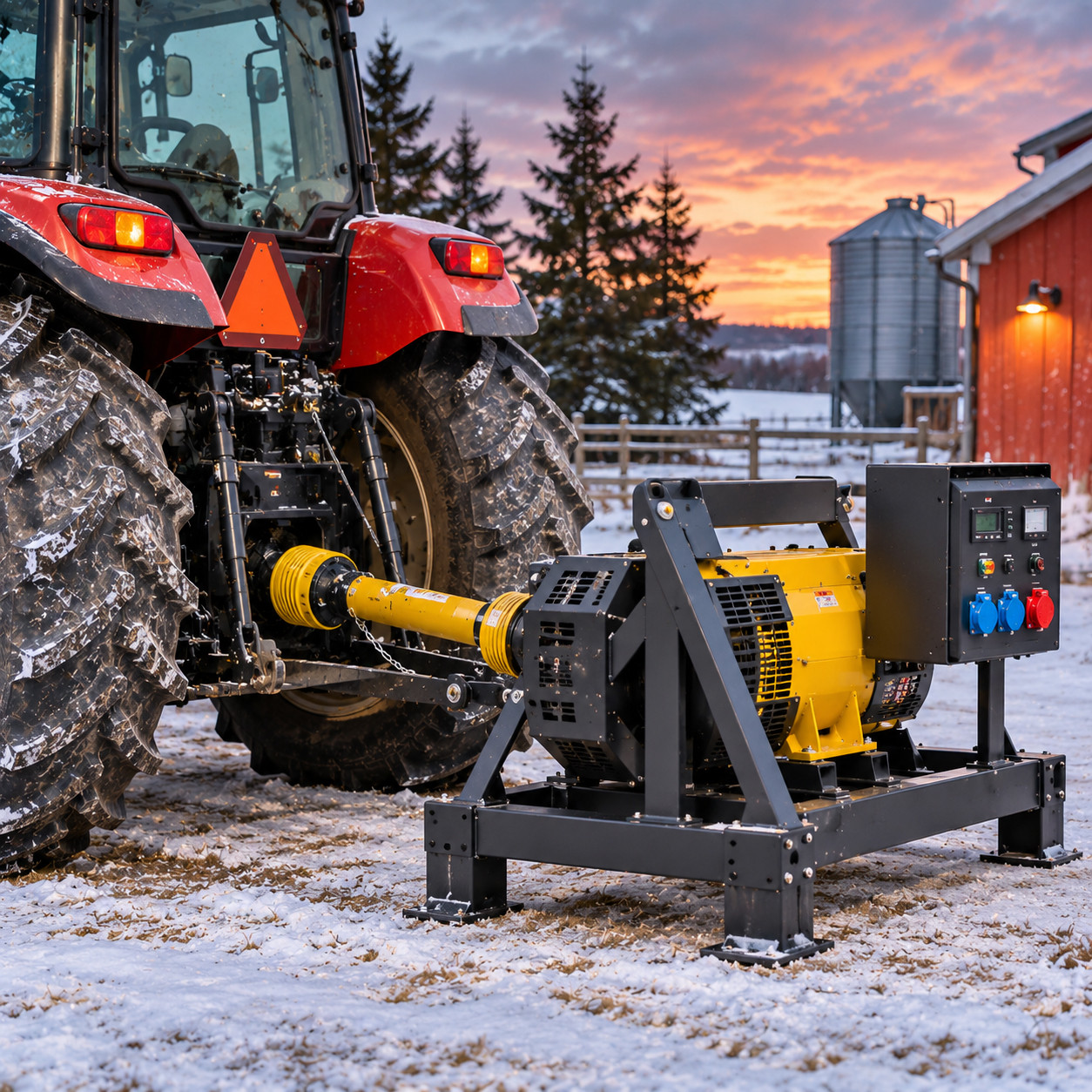
Many tractors are equipped with a power take-off (PTO), a mechanical shaft designed to transfer engine power to implements and other equipment.
Normally, the PTO might operate a mower, baler, auger, or manure spreader. However, it can also drive a properly matched PTO generator.
How a PTO Generator Works
A PTO generator connects to the tractor's power take-off shaft through an appropriate driveline.
When the tractor engine operates at the required speed, the PTO turns the generator, producing electricity.
Depending on the generator's capacity and configuration, that electricity could be used to power:
• Well pumps and pressure systems
• Refrigerators and freezers
• Essential lighting
• Livestock watering equipment
• Selected heating-system components
• Battery chargers and communications equipment
A PTO generator may be especially useful on properties that already have a suitable tractor but don't have a large standalone generator.
However, tractor horsepower and generator capacity must be matched correctly.
A generator rated for 20 kilowatts of electrical output might require approximately 35–45 PTO horsepower, depending on generator efficiency, operating conditions, and the manufacturer's requirements.
A smaller tractor may not have enough available PTO horsepower to operate a large generator at its rated output.
Why PTO Speed Matters
Most conventional PTO generators require a specified shaft speed, commonly 540 or 1,000 rpm, depending on the model.
The tractor must maintain the correct PTO speed to produce electricity at the required frequency.
In North America, most standard electrical equipment is designed for 60-hertz power.
If tractor speed drops significantly under load, the generator's output frequency can also drop.
Depending on the generator's voltage regulation, voltage may also fluctuate.
This could cause problems for motors, electronic controls, and other sensitive equipment.
A PTO generator is therefore not simply a matter of connecting a shaft and letting the tractor idle. Proper engine speed, electrical loading, and output monitoring are essential.
The Disadvantages of Using a Tractor for Power
Although practical, using a tractor as a generator power source has limitations.
A tractor engine may consume considerably more fuel than a dedicated generator producing the same electrical output, particularly when operating under a light load.
The tractor also accumulates engine hours while remaining stationary, increasing maintenance requirements.
And if the tractor is needed to clear snow, move feed, or perform other essential work, the generator must be shut down and disconnected safely before the machine can be used elsewhere.
For a 30-day outage, a PTO generator might be an excellent backup power option, but it wouldn't necessarily be the most fuel-efficient solution for continuous operation.
How Much Fuel Would You Need for 30 Days?
Fuel availability could become one of the biggest limitations during an extended power outage.
A generator is only useful as long as its engine has fuel.
For rural property owners, diesel storage may provide a significant advantage. Farms and acreages sometimes have aboveground fuel tanks used to supply tractors, skid steers, and other equipment.
However, the amount of stored fuel needed to maintain electrical power for a month can be surprisingly large.
A Simple Diesel Consumption Example
Consider a diesel generator that consumes an average of 3 litres of fuel per hour under the electrical load required by the property.
| ILLUSTRATIVE FUEL REQUIREMENTS | ||
| 3 L | 72 L | 2,160 L |
| Per operating hour | Per 24-hour day | Over 30 days |
That's more than 2,000 litres of diesel just to operate one generator continuously for a month.
Actual fuel consumption varies significantly with generator size, engine design, load, and operating conditions.
Fortunately, continuous operation may not be necessary.
Reducing Generator Operating Hours
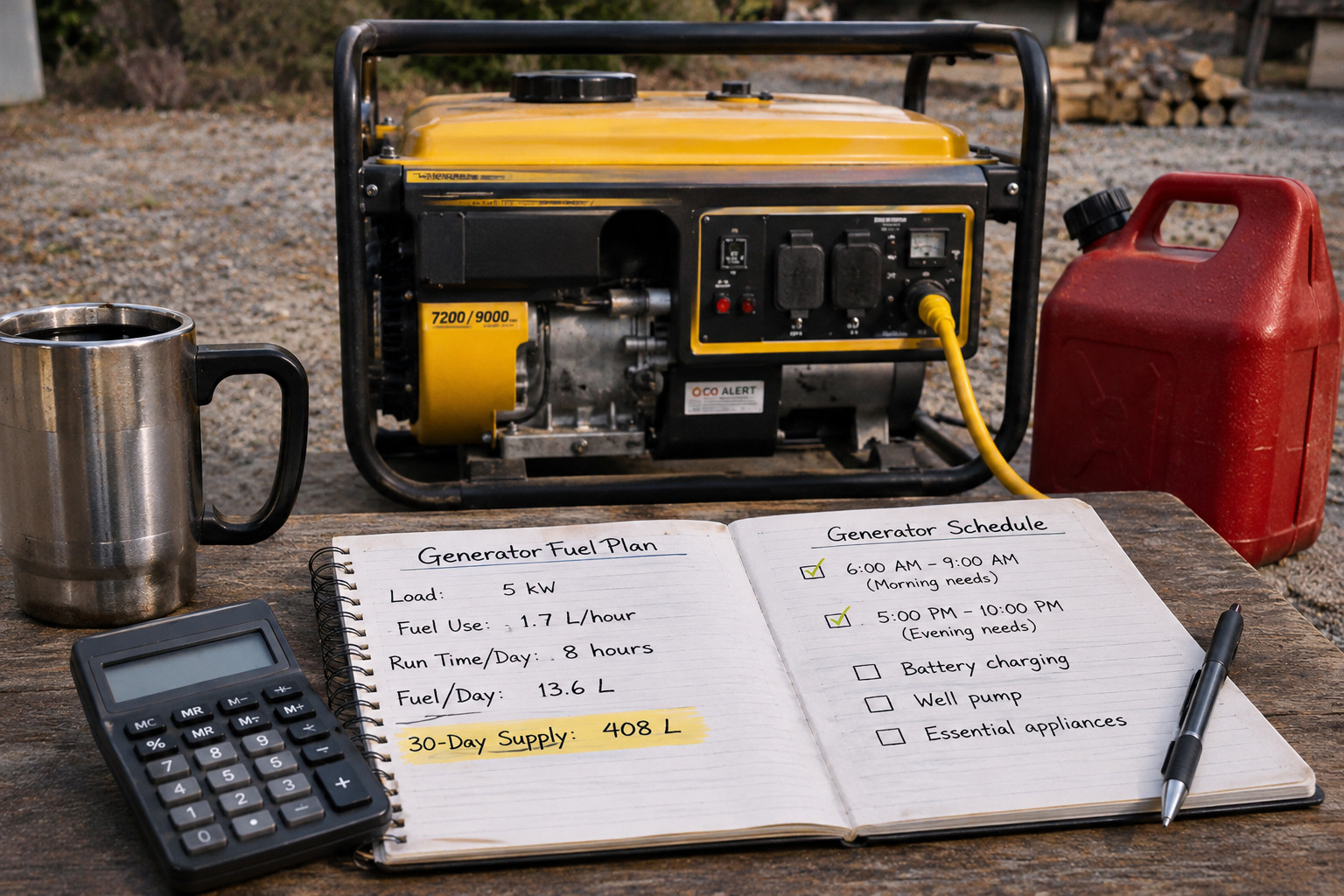
Instead of running a generator around the clock, a property owner might organize electrical demand into scheduled operating periods.
For example, the generator could be used to pump water into an appropriately designed storage tank, recharge a battery bank, operate selected equipment, and support food preservation.
A properly sized battery and inverter system could then supply smaller electrical loads when the generator is shut down.
Example: How operating hours affect fuel requirements
Assuming a constant 3 L/hour consumption whenever the generator operates.
| 24 hours/day |
2,160 L |
| 12 hours/day | 1,080 L |
| 8 hours/day | 720 L |
| 4 hours/day | 360 L |
These figures illustrate operating time, not guaranteed fuel savings. Actual hourly consumption changes with load, and reduced runtime must still meet the property's electrical needs.
The goal would be to produce electricity when it's needed rather than wasting fuel powering unnecessary loads.
Fuel Storage Considerations
Storing large quantities of diesel or gasoline introduces additional responsibilities.
Fuel tanks must be suitable for their contents and installed in accordance with applicable fire, environmental, and storage requirements.
Fuel contamination is another concern.
Water, sediment, and microbial growth can cause problems in stored diesel, particularly when fuel remains unused for extended periods.
Cold weather introduces further complications. Diesel fuel that isn't suitable for low temperatures can experience wax crystallization and filter plugging.
In cold winter conditions, proper winter-grade diesel, fuel treatment where appropriate, and suitable storage practices could make the difference between a functioning engine and one that refuses to start.
A full fuel tank is valuable, but fuel that cannot be delivered cleanly to an engine is of little use.
Keeping Water Flowing Without Grid Electricity
|
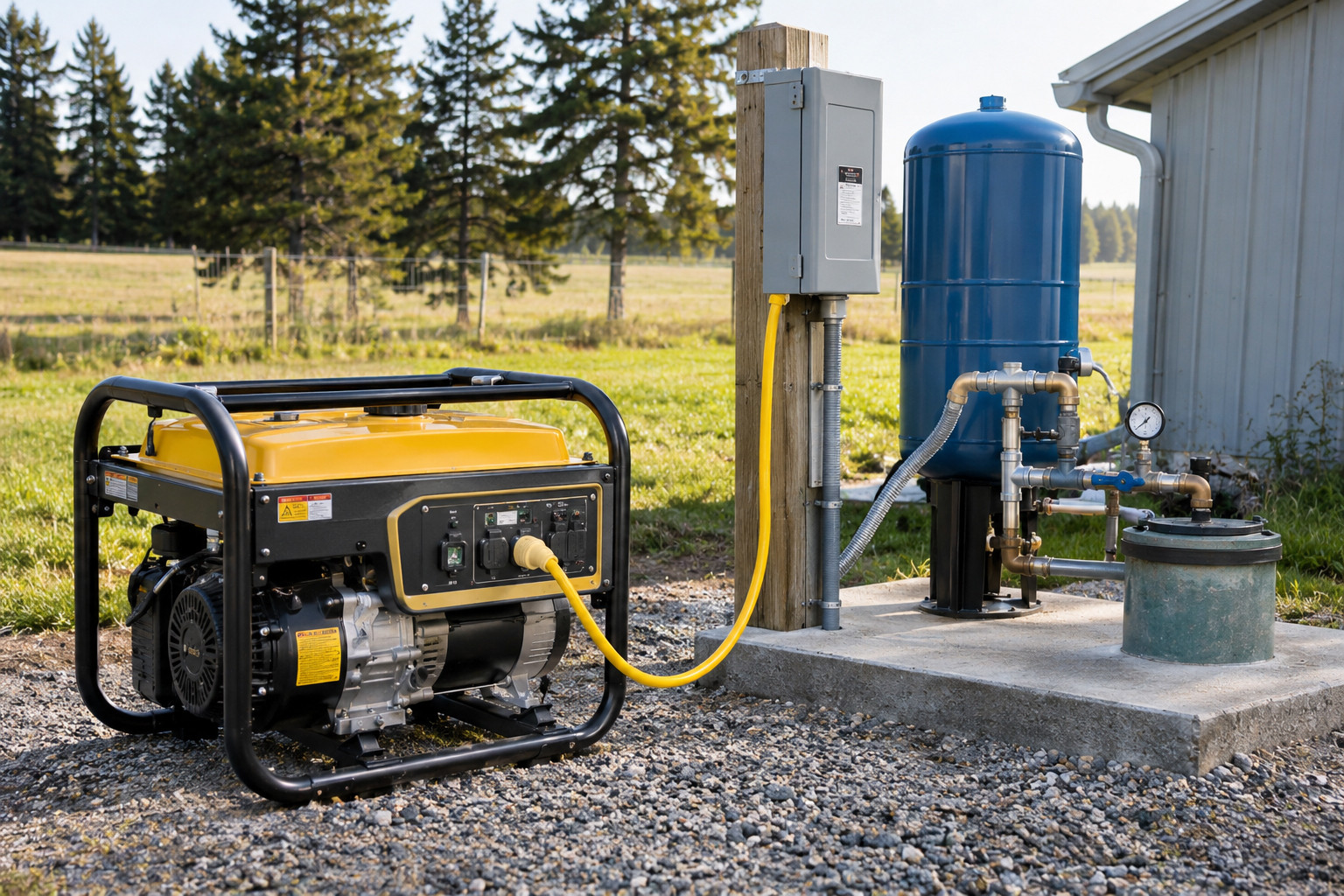
Water could become a more immediate concern than electricity itself. Many rural properties depend on electrically powered well pumps. When grid power fails, those pumps stop operating unless an alternative power source is available. Even if the property has an excellent well with plenty of groundwater, the water may be inaccessible without electricity. Using a Generator to Operate a Well Pump Electric motors commonly require a brief surge of power when starting. A generator that appears large enough based on the pump's running wattage may still be unable to start it. For example, a pump drawing 1,500 watts while running could require several times that amount momentarily during startup, depending on its motor and starting arrangement. Generator selection should therefore be based on the pump's actual electrical specifications, including starting requirements, rather than running wattage alone. |
 |
|
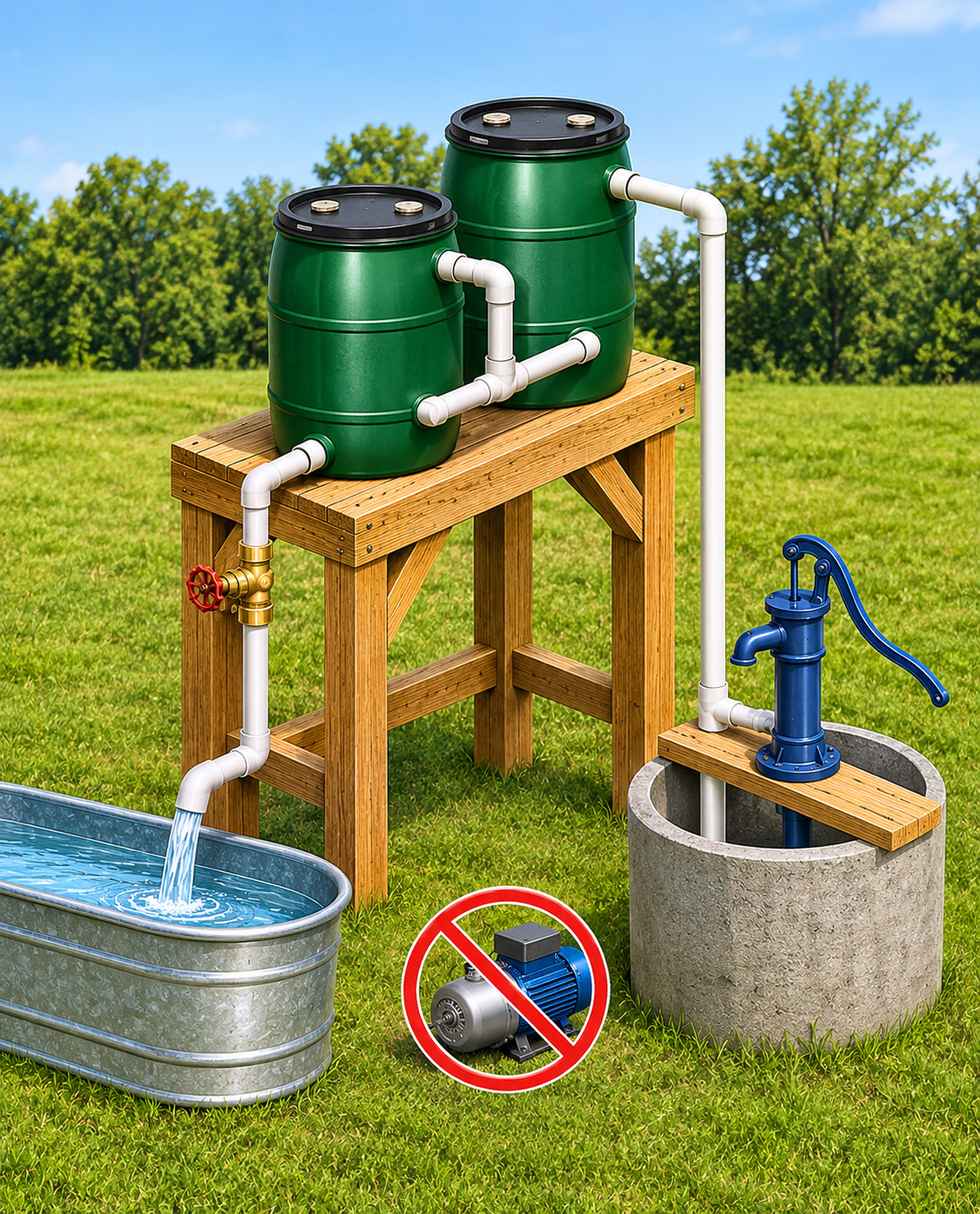
Pumping Water Into Storage Tanks One practical strategy is to use available electricity to fill water storage tanks. Once the water is stored, it may be possible to distribute it using gravity, a smaller pump, or another suitable system. For properties with livestock, stored water could reduce the number of times a large well pump needs to operate. However, gravity-fed distribution requires sufficient elevation difference to produce usable pressure. A tank positioned only slightly above a watering trough may provide adequate flow for some applications but insufficient pressure for household plumbing. Water intended for drinking must also be stored and handled in a way that maintains its safety. |
 |
Could a Tractor Power a Water Pump Directly?
Yes.
Some agricultural water pumps can be driven mechanically through a tractor PTO.
Others use gasoline or diesel engines to operate independently of the electrical grid.
These systems can be useful for transferring water between storage tanks, supplying irrigation equipment, or moving water from an approved source to livestock watering locations.
However, a PTO-driven transfer pump isn't automatically suitable for pumping water from a deep well.
Deep-well systems often require specialized submersible pumps or other equipment designed for the depth, lift, and water requirements involved.
The type of pump matters just as much as the power source.
Could You Keep Livestock Fed and Watered?
For livestock operations, a 30-day power outage could become an animal welfare emergency if essential systems aren't maintained.
The severity would depend on the type of livestock, the season, the number of animals, and the equipment used on the property.
A small pasture-based operation might be relatively manageable, while a large confinement livestock facility could depend heavily on electricity for ventilation, feeding, watering, and environmental controls.
Mechanically Operated Feeding Equipment
Tractors and other diesel-powered equipment can perform many feeding tasks without grid electricity.
Depending on the operation, this could include:
• Moving round or square bales with a tractor and loader.
• Operating PTO-driven feed mixers.
• Transporting feed with a skid steer or utility vehicle.
• Using tractor-powered augers where suitable.
• Clearing access to feed storage areas.
• Moving portable water tanks or troughs.
The ability to operate these machines independently of the grid could be a major advantage.
However, some feed systems use electric motors, computerized controls, or electrically operated gates.
Those systems would need alternative power or a safe manual operating procedure.
|
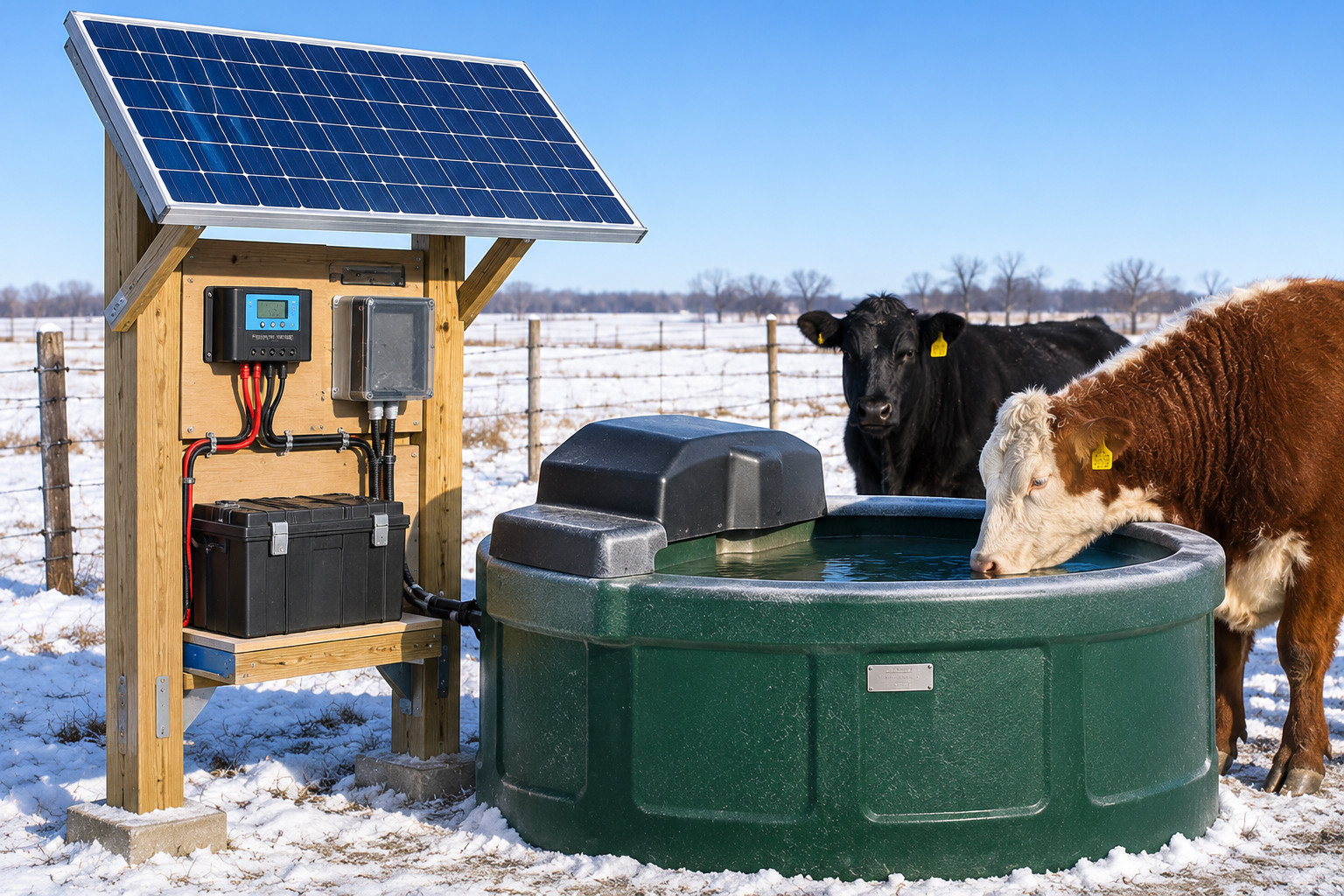
Winter Livestock Watering In freezing temperatures, supplying water becomes more complicated. Electric stock tank heaters and heated automatic waterers may stop functioning during an outage. A tractor can transport water, but that doesn't solve the problem of keeping it from freezing. Depending on the installation, possible alternatives include insulated water storage, properly designed frost-free watering systems, or backup power for critical heaters. Any water-heating or frost-protection method must be appropriate for the installation and safe for animals. Livestock facilities that require powered ventilation also need particular attention. In enclosed barns, ventilation failures can become dangerous long before the 30-day period is over. |
 |
|
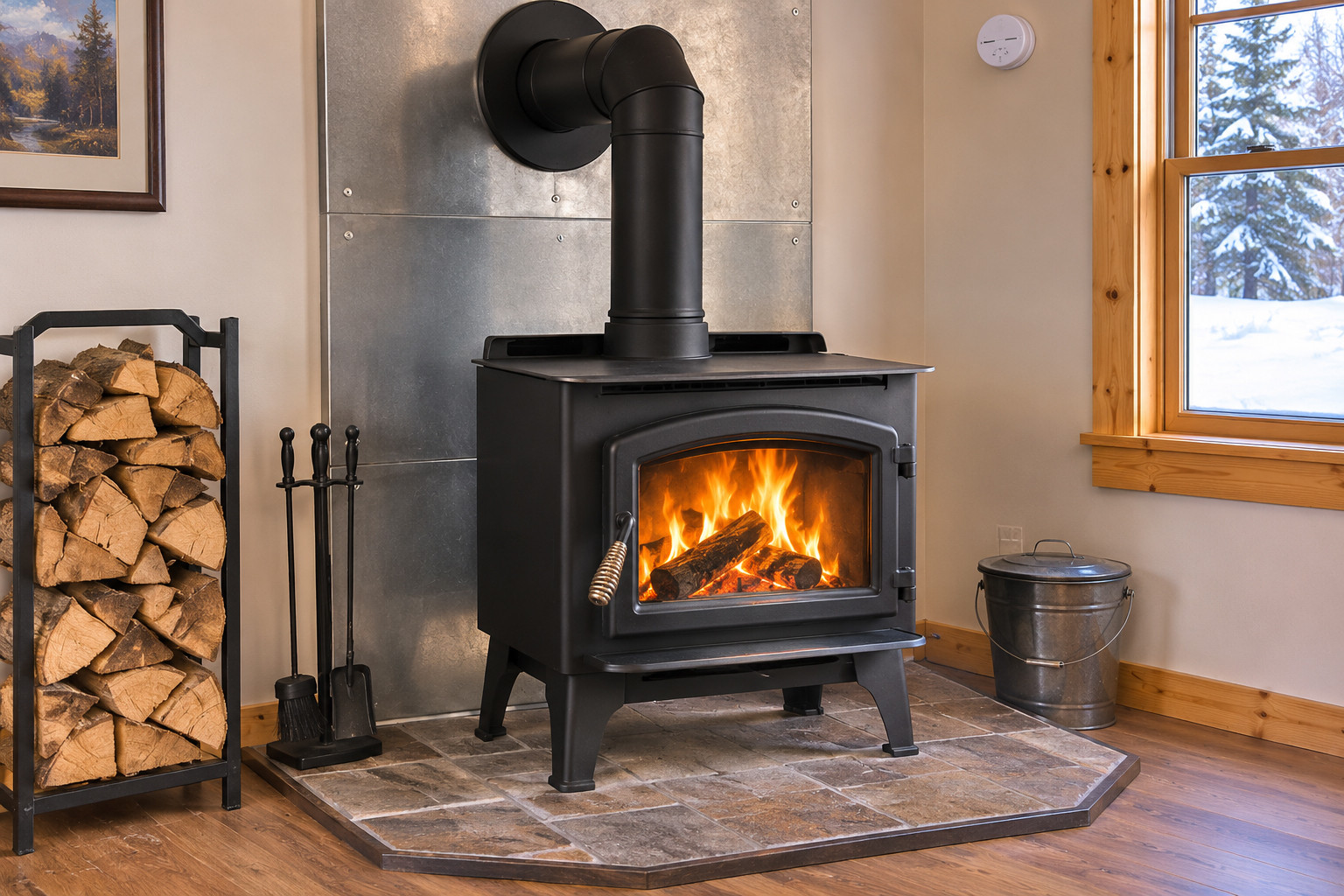
Heating Buildings Without Depending Entirely on Electricity Heating a rural home or workshop during a prolonged winter outage presents a different challenge. Even buildings heated with propane, natural gas, or heating oil may rely on electricity to operate circulation fans, pumps, ignition systems, and controls. Without power, the heating system may stop functioning despite having an adequate fuel supply. Wood-Burning Heating Systems A properly installed, maintained, and approved wood stove can provide heat without electricity. For some rural properties, that could be a significant advantage. However, not every wood-burning appliance operates independently of electricity. Outdoor wood boilers and some indoor boiler systems use electrically powered circulation pumps and controls. Certain pellet stoves also require electricity for fuel feeding and combustion fans. The exact heating system must be evaluated before assuming it will function during an outage. |
 |
Using a Generator to Support Existing Heating
A generator may be able to supply the electrical components of an existing heating system.
This could require considerably less electrical power than attempting to heat an entire building with portable electric heaters.
For example, supplying electricity to a compatible furnace blower and controls may allow an existing fuel-fired heating system to continue operating.
The electrical requirements and safe connection method must be confirmed for the specific equipment.
In extremely cold conditions, protecting water lines, pressure tanks, and plumbing in unheated buildings may be just as important as maintaining comfortable living temperatures.
What Mechanical Equipment Would Be Most Valuable?
Not every useful machine needs to generate electricity.
During a prolonged outage, the ability to move materials, maintain access, and perform repairs could be equally important.
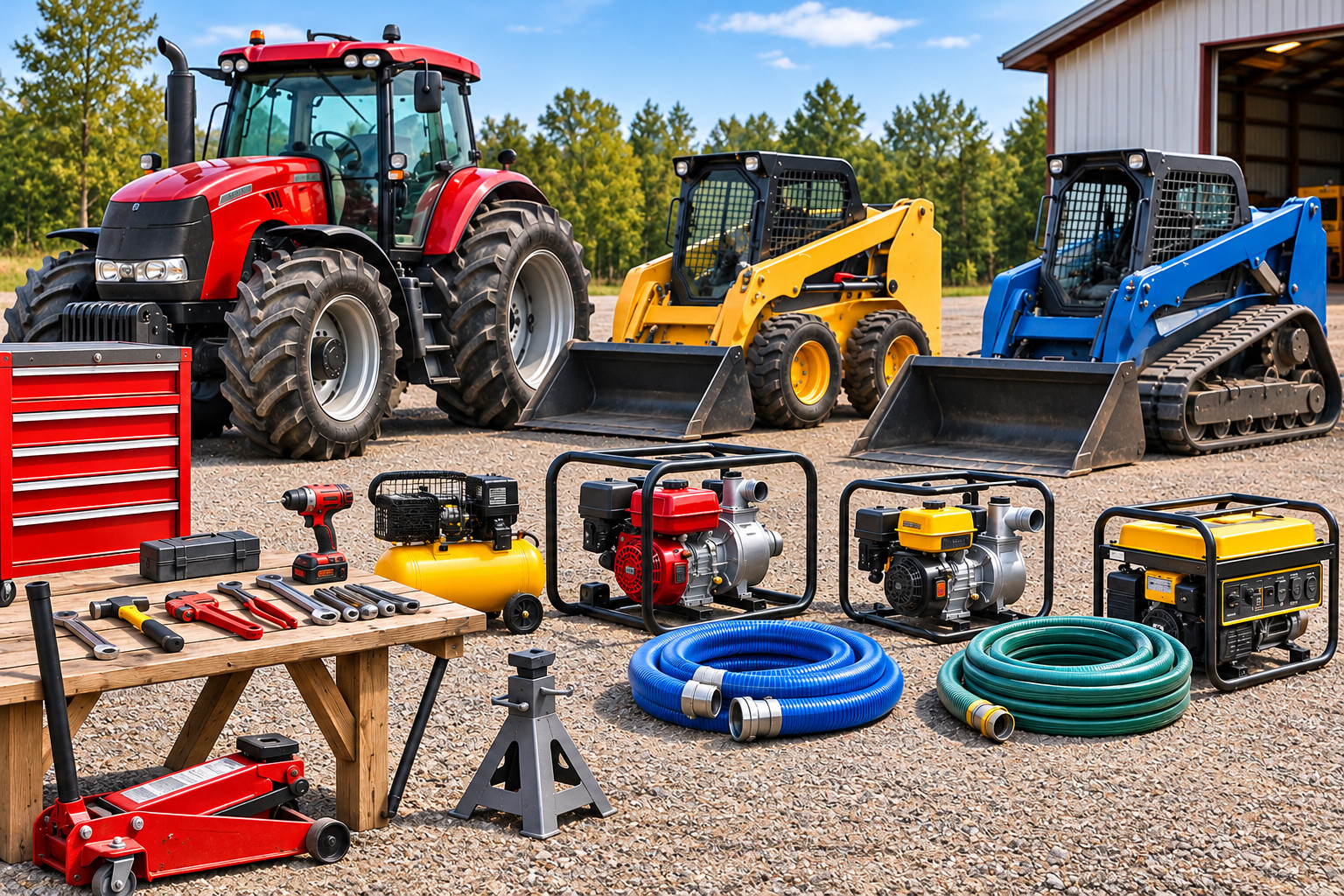
Tractors
Useful for snow clearing, moving feed, operating PTO equipment, transporting materials, and supporting general property maintenance.
Skid Steers and Compact Track Loaders
Useful for moving firewood, handling feed, clearing debris, maintaining access routes, and moving supplies around buildings.
Engine-Driven Water Pumps
Capable of transferring water between suitable sources and storage locations without grid electricity.
Manual Tools and Mechanical Equipment
Hand tools, mechanical jacks, hand-operated hoists, and other non-electric equipment can support repairs and maintenance when electrical power is limited.
A machine's usefulness would also depend on its condition.
A tractor that hasn't been started in six months, has a weak battery, or requires repairs may offer little immediate value during an emergency.
Routine maintenance becomes part of emergency preparedness.
Could You Maintain Your Equipment for an Entire Month?
Running generators and machinery for extended periods creates another challenge: maintenance.
A generator operating continuously for 30 days would accumulate 720 engine hours.
That's a substantial amount of operating time.
Depending on the engine and manufacturer's maintenance schedule, it could require multiple oil changes, filter servicing, and inspections during the outage.
A property owner should have the necessary supplies available before they're needed.
These could include engine oil, oil filters, fuel filters, coolant, belts, appropriate lubricants, spare batteries, and basic repair tools.
Air filters may also need attention, particularly if machinery is operating in dusty conditions.
The Problem With Modern Electronic Equipment
Modern agricultural and construction equipment frequently uses electronic engine controls, sensors, computerized displays, and emissions systems.
These systems provide important operational benefits, but they can complicate repairs when diagnostic equipment, replacement parts, or technical support are unavailable.
Older mechanically controlled diesel engines may be easier to troubleshoot in some circumstances because they have fewer electronic components.
However, older doesn't automatically mean more reliable.
A poorly maintained mechanical diesel engine may be less dependable than a newer electronically controlled machine in excellent condition.
For an extended outage, equipment condition, parts availability, and the owner's ability to perform routine maintenance may matter more than the age of the machine.
|
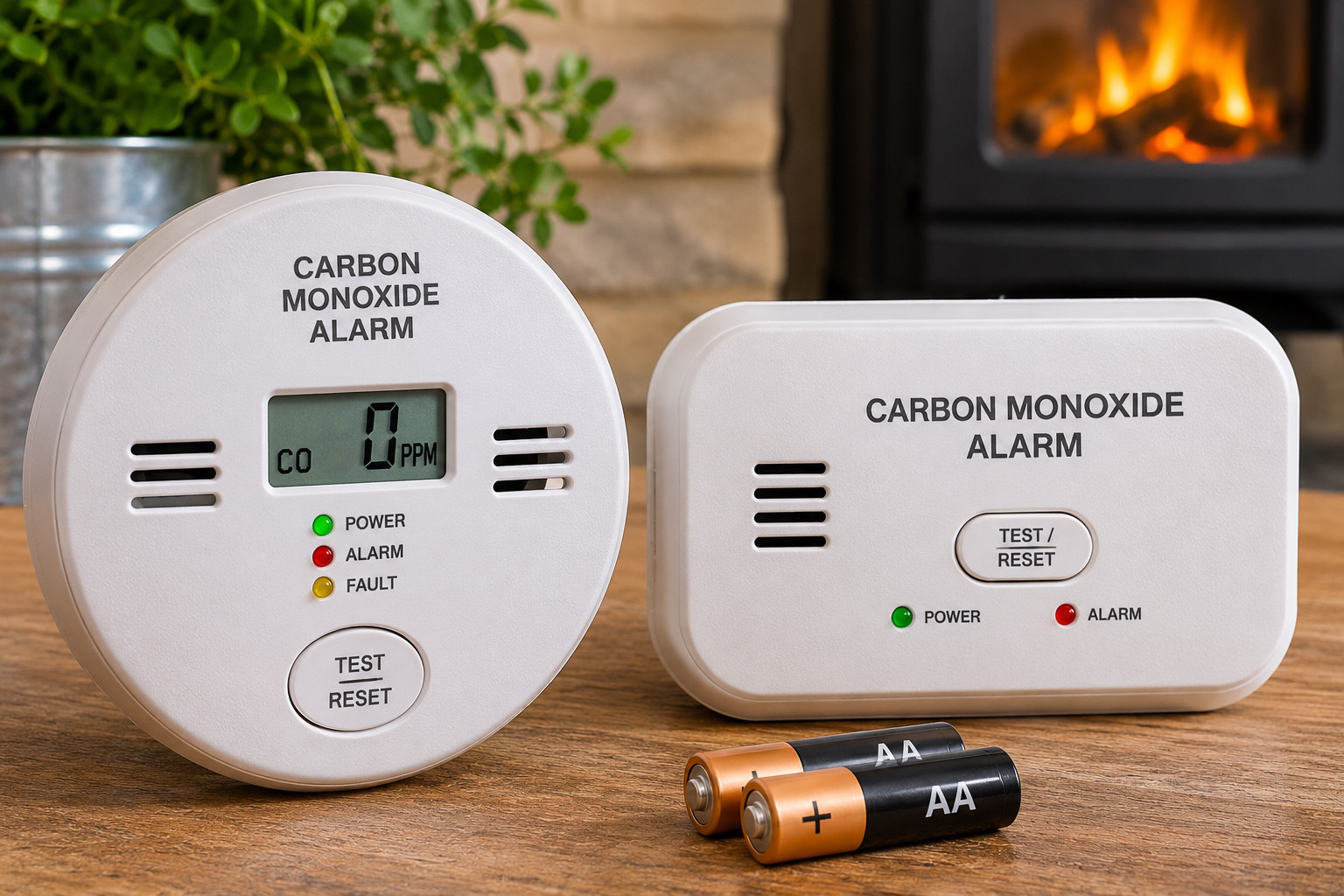
The Safety Risks of Operating Without Grid Power An extended power outage may encourage property owners to improvise, but certain shortcuts can be extremely dangerous. Generator Placement and Carbon Monoxide Portable and tractor-driven generators must operate outdoors in properly ventilated locations, well away from doors, windows, vents, and occupied buildings. Generators must never be operated inside homes, garages, barns, or other enclosed or partially enclosed spaces. Carbon monoxide is colourless and odourless, and dangerous concentrations can accumulate quickly. Battery-powered carbon monoxide alarms should be part of any emergency power plan. |
 |
Preventing Electrical Backfeeding
A generator must never be connected to a building by plugging it into an ordinary receptacle or using an improvised cord arrangement.
This can energize utility lines and endanger utility workers, occupants, and other people.
A properly installed transfer switch or other approved transfer equipment is necessary to safely isolate generator power from the utility supply.
A qualified electrician should design and install the connection according to applicable electrical requirements.
Tractor and PTO Safety
PTO-driven equipment introduces additional hazards.
Rotating drivelines can cause severe injuries, and improper shaft alignment or damaged guards can create dangerous operating conditions.
PTO guards and shields must remain in place, and the equipment must be operated according to manufacturer instructions.
Generators and PTO equipment should also be protected from weather exposure as required by their design, without enclosing combustion engines or restricting cooling airflow.
Fuel Handling
Stored fuel creates fire, spill, and environmental risks.
Fuel containers and tanks must be appropriate for their intended use, and refuelling should follow the equipment manufacturer's instructions.
Engines and hot exhaust components should be allowed to cool before refuelling when required.
Fuel storage locations must also be protected from accidental damage by vehicles and machinery.
What Would a 30-Day Power Outage Look Like?
Maintaining a rural property without grid electricity would require more than simply keeping a generator running.
The owner's priorities would likely change as the outage continued.
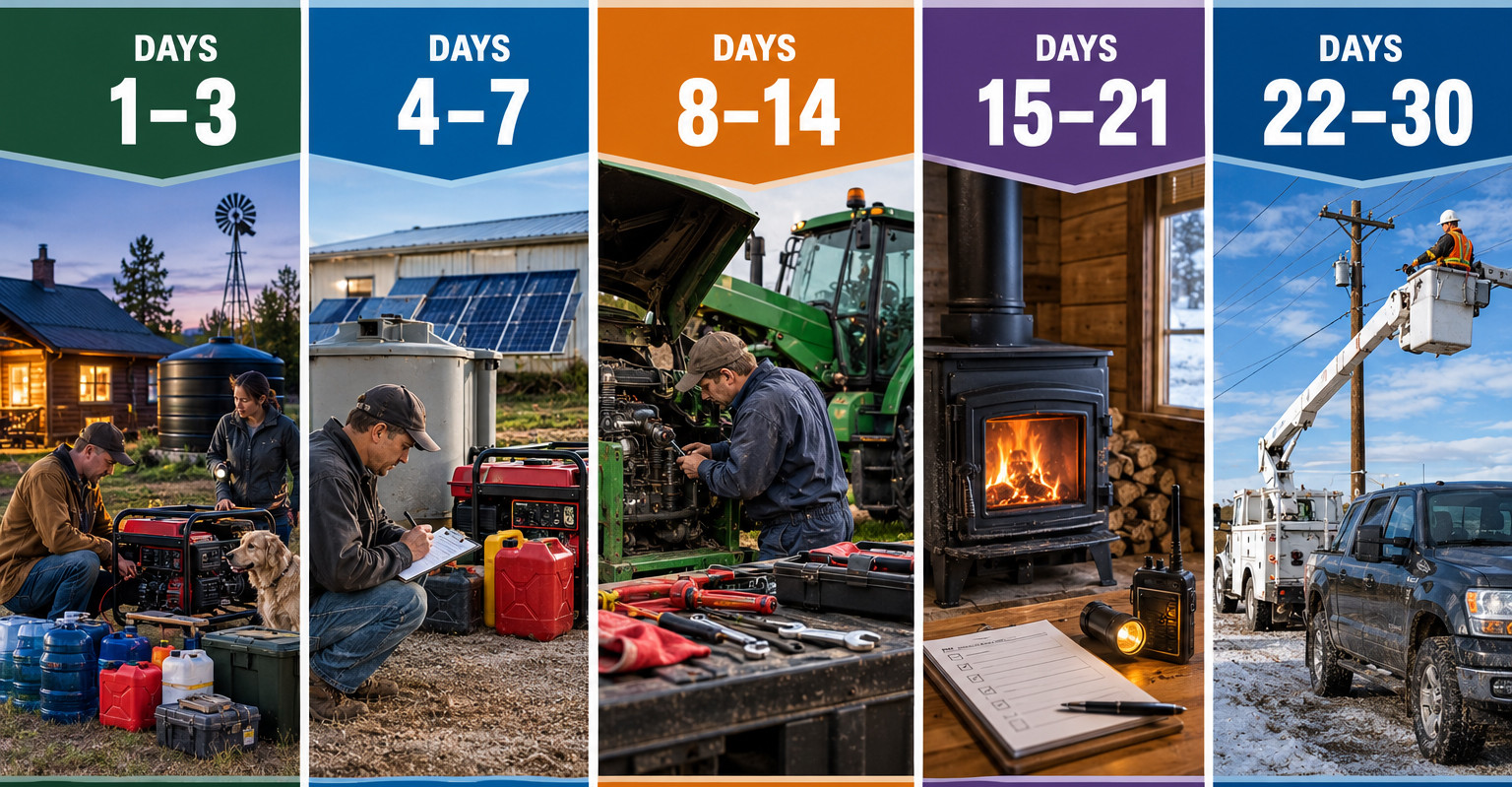
Days 1–3: Establish Essential Services
Confirm the outage, protect occupants and animals, establish safe backup power, secure water supplies, assess fuel availability, and identify equipment that must remain operational.
Days 4–7: Reduce Consumption
Review fuel usage, consolidate electrical loads, establish generator operating schedules, and determine whether available fuel and supplies can support another three weeks.
Days 8–14: Maintain Equipment and Supplies
Inspect machinery, perform maintenance according to operating hours, monitor stored water and fuel, and address emerging problems before they cause equipment failures.
Days 15–21: Preserve Critical Resources
Reassess fuel reserves, prioritize heating and water, minimize unnecessary equipment operation, and maintain communication with utility providers and emergency services.
Days 22–30: Sustain Operations and Prepare for Restoration
Continue essential property operations, protect remaining resources, inspect electrical equipment for potential damage, and prepare for the safe restoration of normal power.
Of course, an outage lasting 30 days wouldn't necessarily follow such a predictable schedule.
Equipment could fail on the second day. Fuel deliveries might become available after a week. Severe weather could make operating conditions significantly more difficult.
The purpose of planning isn't to predict every problem. It's to ensure that the property has enough flexibility to respond when conditions change.
Could a Rural Property Become More Self-Sufficient?
One of the most interesting aspects of rural power preparedness is that it doesn't necessarily require a completely off-grid lifestyle.
Instead, it involves identifying which systems are dependent on electricity and finding practical ways to keep them functioning when the grid is unavailable.
A property with a suitable tractor, properly installed backup generator, adequate fuel, accessible water storage, and a reliable alternative heating source may be better positioned to withstand an extended outage than one that relies entirely on a single electrical supply.
Additional improvements could include:
• Installing approved generator transfer equipment.
• Establishing safe, adequate fuel storage.
• Adding appropriately designed water storage capacity.
• Maintaining a battery and inverter system for smaller electrical loads.
• Keeping essential machinery serviced and ready for use.
• Identifying manual or mechanical alternatives for critical tasks.
• Developing a realistic plan for livestock, heating, and emergency access.
None of these measures guarantees that a property can operate independently for an entire month.
Weather, fuel availability, equipment failures, water requirements, and the needs of the people and animals on the property will ultimately determine what's possible.
And in some circumstances, temporarily relocating people or animals may be safer than attempting to maintain normal operations.
Could You Really Make It 30 Days?
Thirty days without grid electricity would be a serious challenge for almost any rural property.
However, the machinery already found on many farms and acreages could provide a surprising amount of operational independence.
A tractor could generate electricity, clear access routes, and operate mechanical equipment. Diesel generators could keep essential electrical systems functioning. Engine-driven pumps could move water, while fuel storage and properly maintained machinery could help sustain operations.
The greatest challenge might not be producing enough power. It could be managing fuel consumption, maintenance requirements, water availability, and equipment reliability over an extended period.
The difference between surviving a power outage and maintaining a functioning rural property comes down to preparation, equipment capability, and resource management.
