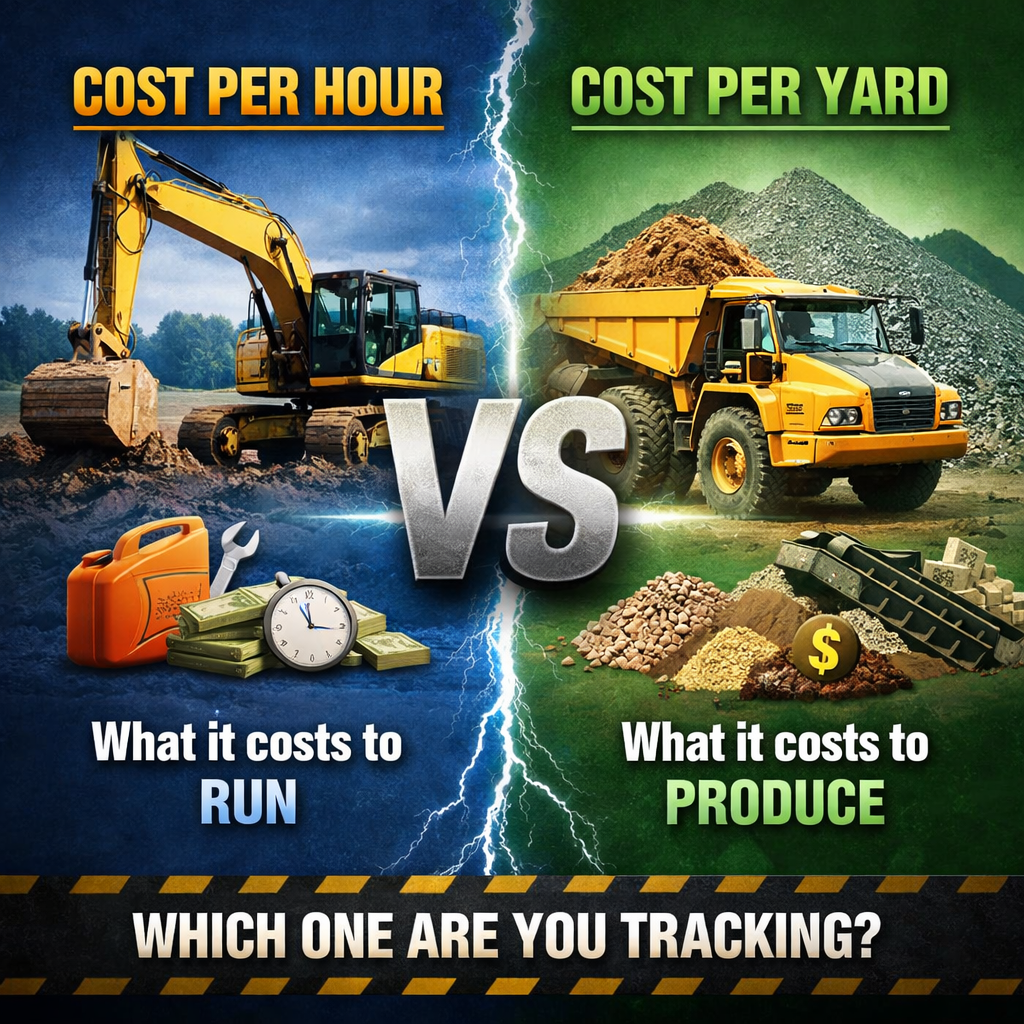
Cost Per Hour vs. Cost Per Yard: Which Should You Track?
When it comes to managing heavy equipment operations, few debates are as practical—and as misunderstood—as whether to track cost per hour or cost per yard. Both metrics are valuable, but relying on just one can leave blind spots in your operation. The real question isn’t which is better—it’s when and why to use each.
Understanding Cost Per Hour
Cost per hour is the most straightforward metric. It tells you how much it costs to run a machine for every hour it operates. This includes:
• Fuel
• Maintenance and repairs
• Operator wages
• Depreciation
• Insurance and overhead
This metric is easy to calculate and widely used because it gives you a baseline for equipment expense. It’s especially useful for:
• Comparing machines
• Budgeting and forecasting
• Determining rental or billing rates
However, cost per hour has a major limitation: it doesn’t account for productivity.
Two machines can have the same hourly cost but produce vastly different results depending on material conditions, operator skill, or site layout. That’s where cost per yard comes in.
____________________________________________________________________________________
Understanding Cost Per Yard
Cost per yard (or per tonne, depending on your operation) measures how much it costs to move or process a unit of material. This is where performance meets cost.
To calculate it, you divide total operating cost by total production:
Cost per Yard = Total Cost ÷ Total Yards Processed
This metric gives you real insight into efficiency. It answers questions like:
• Are we moving material as efficiently as we should be?
• Is this machine the right size for the job?
• Where are we losing money in the process?
Cost per yard is especially valuable in:
• Earthmoving
• Aggregates
• Mining and wash plant operations
Unlike cost per hour, this metric reflects the reality of jobsite conditions. If production drops due to poor haul road conditions or material type, your cost per yard will increase—even if your hourly cost stays the same.
____________________________________________________________________________________
The Problem with Choosing Just One
Tracking only cost per hour can give you a false sense of control. You might think you’re operating efficiently because your hourly costs are in line—but if production is low, you’re actually losing money.
On the flip side, focusing only on cost per yard without understanding your hourly costs can make it difficult to pinpoint why performance is off. Is it fuel burn? Downtime? Operator inefficiency?
Each metric tells part of the story—but not the whole story.
____________________________________________________________________________________
The Smarter Approach: Track Both
The most effective operations track both cost per hour and cost per yard—and use them together.
Here’s how they complement each other:
• Cost per hour tells you what it costs to run
• Cost per yard tells you what it costs to produce
When you combine the two, you can:
• Identify underperforming equipment
• Optimize fleet selection
• Improve operator efficiency
• Adjust workflows to increase production
For example, if your cost per hour is stable but your cost per yard is rising, you likely have a production issue—not a cost issue. That’s a powerful insight you can act on immediately.
____________________________________________________________________________________
Real-World Example
Imagine two loaders:
• Loader A costs $180/hour and moves 120 yards/hour
• Loader B costs $200/hour and moves 180 yards/hour
At first glance, Loader A seems cheaper. But when you break it down:
• Loader A: $1.50 per yard
• Loader B: $1.11 per yard
Despite the higher hourly cost, Loader B is significantly more efficient—and more profitable.
____________________________________________________________________________________
If you’re only tracking cost per hour, you’re measuring expense—but not performance. If you’re only tracking cost per yard, you’re seeing results—but not the cause.
The most successful operations don’t choose between the two—they use both to get a complete picture.
Because in this industry, it’s not just about what you spend—it’s about what you move.