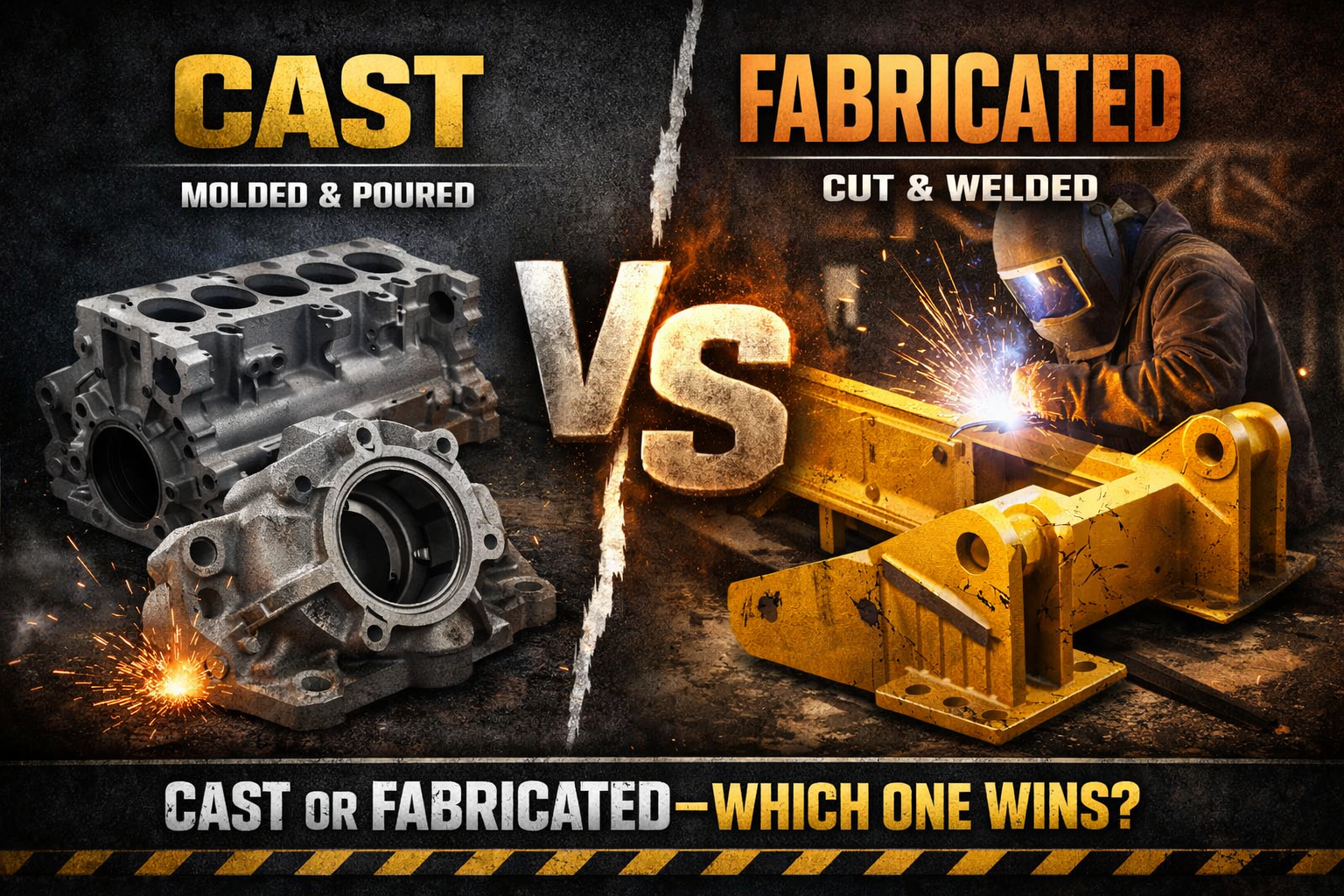
Cast vs Fabricated Components: Where Each Is Used and Why?
In the world of heavy machinery, automotive engineering, and industrial equipment, the choice between cast and fabricated components can make a huge difference in performance, cost, and durability. While both methods produce strong parts, they are fundamentally different in how they are made and where they excel. Understanding these differences is key for engineers, operators, and enthusiasts alike.
What Are Cast Components?
Casting is a manufacturing process where molten metal is poured into a mold and allowed to solidify. Once cooled, the part takes the exact shape of the mold. Casting is one of the oldest metal-forming methods and is widely used today for complex shapes.
Advantages of Cast Components:
- Complex Shapes: Castings can form intricate geometries that would be difficult or impossible with other methods.
- Strength in All Directions: Properly designed castings distribute stress evenly, making them ideal for parts under multi-directional loads.
- Reduced Machining: Since castings can be near-net shape, less material removal is required.
Typical Uses:
- Engine blocks and cylinder heads in heavy equipment
- Hydraulic housings and pump bodies
- Crankshafts and gear housings where uniform strength is critical
What Are Fabricated Components?
Fabrication refers to cutting, bending, and assembling metal pieces—often through welding or bolting—to form a component. Unlike casting, fabrication starts with solid metal stock rather than molten metal.
Advantages of Fabricated Components:
- Flexibility: Fabrication allows designers to easily adjust dimensions or repair parts.
- Material Efficiency: Only the required material is used, reducing waste for large structures.
- Large Components: Fabrication is ideal for oversized parts that would be difficult to cast.
Typical Uses:
- Machine frames and booms in excavators and cranes
- Chassis for trucks and heavy equipment
- Structural supports and brackets in construction machinery
How Engineers Choose Between Casting and Fabrication
The decision often comes down to shape complexity, load requirements, size, and cost:
- Complex Geometries: If a part has intricate internal passages or curved surfaces, casting is usually preferred.
- Size Limitations: Extremely large components are often easier to fabricate than cast.
- Load and Stress Considerations: Parts subjected to high and multi-directional stress benefit from casting. Simple beams and brackets often do well as fabricated structures.
- Production Volume: Casting is cost-effective for high-volume production, while fabrication is better for low-volume or custom components.
Combining Both Approaches
In modern machinery, designers often use a hybrid approach. For example, a cast gear housing may be welded to a fabricated frame, taking advantage of the strengths of both methods. This combination ensures durability, flexibility, and cost-effectiveness.
Both cast and fabricated components have their places in heavy machinery and industrial applications. Casting shines when complex shapes and uniform strength are needed, while fabrication excels in flexibility, size adaptability, and efficiency. Understanding the strengths of each method allows engineers to design machines that are not only strong and reliable but also efficient to manufacture.