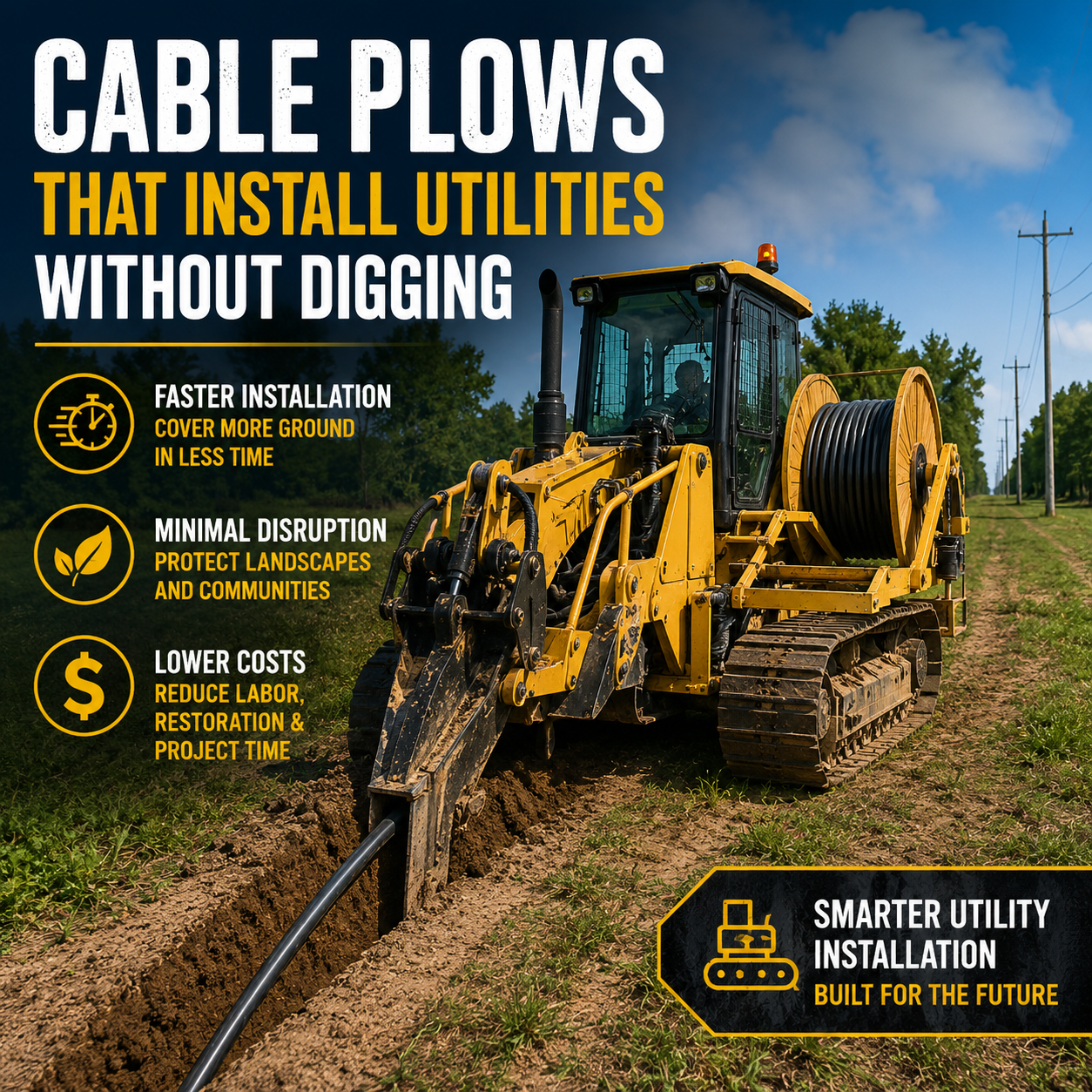
Cable Plows That Install Utilities Without Digging
Most people assume that installing underground utilities means excavators, trenches, piles of dirt, and weeks of cleanup. While traditional trenching certainly has its place, there's another piece of equipment that quietly installs thousands of miles of underground cable and pipe every year with minimal surface disturbance: the cable plow.
From rural internet expansion to underground power lines and irrigation systems, cable plows have become indispensable for utility contractors looking to work faster, cheaper, and with less environmental impact. Although they rarely receive the attention given to excavators, bulldozers, or trenchers, these specialized machines have transformed how underground infrastructure is built.
What Is a Cable Plow?
A cable plow is a heavy machine designed to install underground cable, conduit, or small-diameter pipe without excavating an open trench.
Instead of removing soil, the machine pulls a large, narrow blade through the ground.. Attached to the rear of the blade is a feed tube that guides cable or pipe into the slit created by the blade. As the blade passes, the natural pressure of the surrounding soil closes behind it, leaving little evidence that anything was installed below.
The result is a buried utility line with virtually no trench to refill or landscape to restore.
How Does It Work?
The process is surprisingly elegant:
- The cable or conduit is loaded onto reels.
- The material feeds through rollers into a chute behind the plow blade.
- The blade slices through the soil to the desired depth.
- The cable is deposited into the opening.
- The surrounding soil naturally collapses and seals around the installation.
In many cases, a finished installation is almost invisible from the surface after only a short time.
Common Applications
Cable plows are used to install:
- Fiber optic cable
- Telephone lines
- Electrical distribution cable
- Rural power services
- CATV cable
- Water service lines
- Irrigation pipe
- Gas service tubing (where permitted)
- Communications conduit
They're especially effective over long, uninterrupted distances.
Why Contractors Prefer Cable Plows
Incredible Speed
Compared to trenching, cable plowing can dramatically reduce installation time.
Rather than excavating, hauling spoil, laying conduit, backfilling, and compacting, the cable is installed in a single continuous operation.
Under favorable conditions, contractors can install several miles of cable in a single day.
Minimal Surface Damage
One of the greatest advantages is preserving the landscape.
Cable plows leave:
- No open trench
- Very little displaced soil
- Minimal restoration work
- Reduced erosion risk
- Less disruption to vegetation
This makes them ideal for:
- Agricultural fields
- Golf courses
- Parks
- Road shoulders
- Utility easements
- Residential developments
Lower Project Costs
Because there is less excavation and restoration, projects often require:
- Fewer workers
- Less equipment
- Reduced trucking
- Lower fuel consumption
- Shorter project schedules
For long utility runs, these savings can be substantial.
Different Types of Cable Plows
Ride-On Cable Plows
These resemble bulldozers or large tracked tractors with specialized rear-mounted plow assemblies.
They offer:
- Greater pulling force
- Higher productivity
- Deep installation capability
- Better performance in difficult soils
Vibratory Cable Plows
These use vibration to reduce soil resistance.
Advantages include:
- Easier pulling
- Less disturbance
- Reduced draft force
- Improved performance in compact soils
Tractor-Mounted Units
Some cable plows attach to agricultural or utility tractors.
These are commonly used for:
- Irrigation installation
- Farm electrical service
- Rural communications
- Smaller utility projects
Soil Conditions Matter
Cable plows perform best in:
- Loam
- Clay
- Sandy soils
- Moist ground
They become less efficient in:
- Rocky terrain
- Large boulders
- Frozen ground
- Heavy bedrock
In difficult ground, trenchers or horizontal directional drilling (HDD) may be better choices.
How Deep Can They Install?
Installation depth depends on the machine and application.
Typical ranges include:
- 12 inches (30 cm)
- 24 inches (60 cm)
- 36 inches (90 cm)
- Up to 60 inches (1.5 m) on larger machines
Depth is carefully controlled using hydraulic systems and laser or GPS guidance.
Modern Technology Improves Accuracy
Today's cable plows are far more sophisticated than earlier models.
Many now feature:
- GPS positioning
- Automatic depth control
- Digital mapping
- Utility recording systems
- Machine guidance
- Electronic tension monitoring
This allows contractors to document exactly where utilities are buried for future maintenance and repairs.
Cable Plows vs. Trenchers
|
Cable Plow |
Trencher |
|
Minimal surface disturbance |
Open trench required |
|
Very fast over long distances |
Better for complex installations |
|
Little restoration needed |
Significant cleanup required |
|
Lower labor requirements |
More excavation equipment |
|
Best in open terrain |
Better around obstacles |
Both machines remain essential, but each excels under different conditions.
Limitations
Cable plows are not suitable for every project.
Challenges include:
- Existing underground utilities
- Urban environments
- Tight workspaces
- Numerous crossings
- Heavy rock
- Precision installations around structures
Utility locating is essential before every installation.
Expanding Broadband Is Driving Demand
As governments and telecommunications companies continue expanding high-speed internet into rural areas, cable plows have become one of the primary machines used to install fiber optic networks.
Because they can install long sections quickly with minimal disruption to farmland and roadways, they are a key part of modern broadband infrastructure projects.
A Quiet Workhorse of Utility Construction
Cable plows may not attract attention like massive mining shovels or towering cranes, but they perform one of the construction industry's most efficient jobs. By placing cable and pipe underground in a single pass, they reduce labor, protect landscapes, and speed up infrastructure projects that connect homes, farms, and businesses.
The next time you drive past a freshly installed fiber optic line or new rural power service with barely a trace of construction, there's a good chance a cable plow—not a trencher—did the work. It's another example of how specialized heavy equipment solves complex challenges with remarkable efficiency.