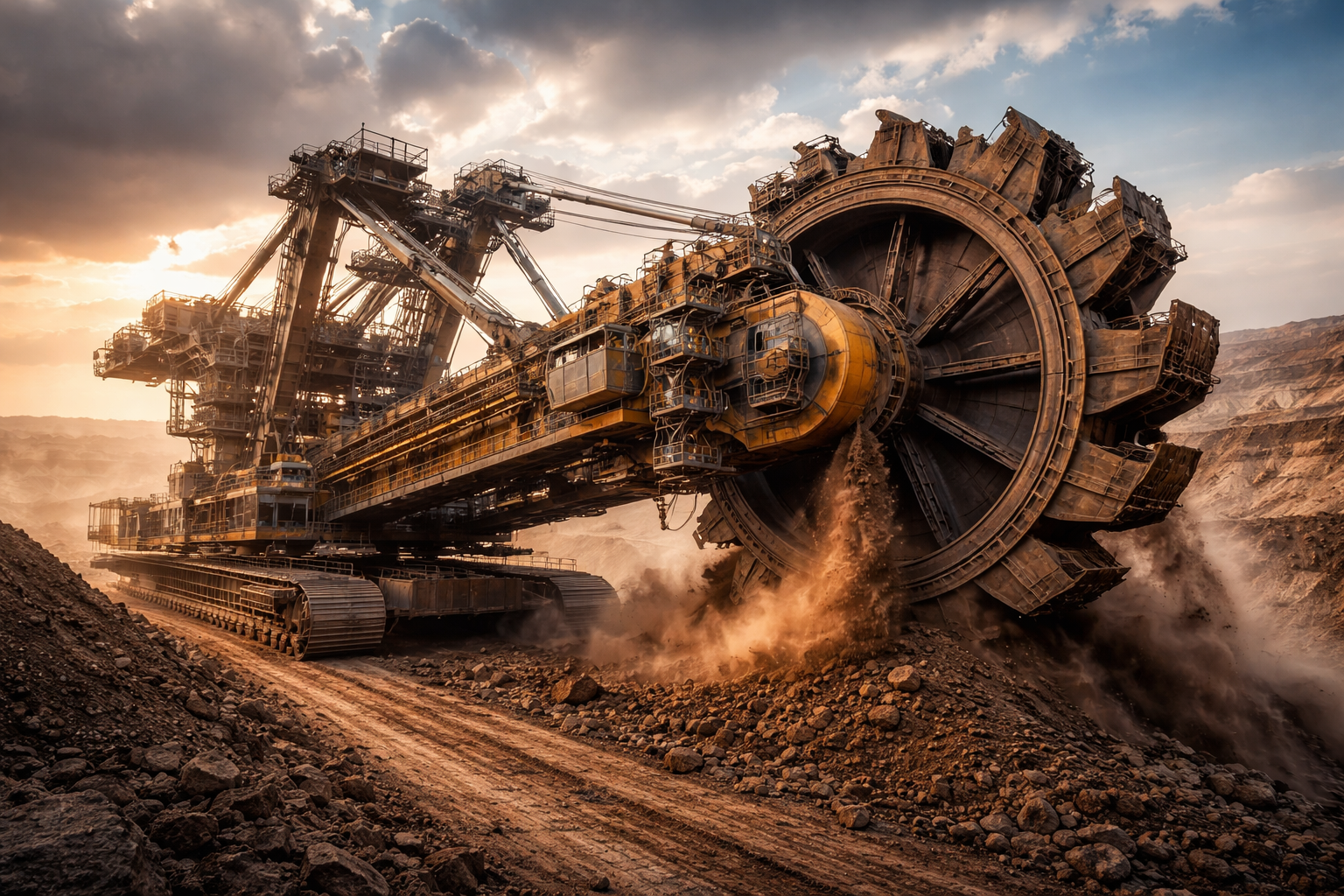
Bucket-Wheel Excavators: Giants of the Mining World
When it comes to moving massive amounts of earth, few machines can compete with the bucket-wheel excavator (BWE). These towering giants, sometimes as tall as a 10-story building and stretching hundreds of feet long, are the heavyweights of the mining world—and they’re as fascinating as they are intimidating.
What Is a Bucket-Wheel Excavator?
A bucket-wheel excavator is a continuous digging machine used primarily in surface mining. Its defining feature is the enormous rotating wheel mounted at the front, studded with dozens of buckets that scoop up soil, coal, or other minerals as the wheel turns. The material is then conveyed through an integrated system of belts and discharged for processing or transport.
Some of the largest BWEs weigh over 13,000 tons, move at a speed of just a few meters per minute, and can excavate over 200,000 cubic meters of material per day. To put that in perspective, that’s roughly the volume of 80 Olympic-sized swimming pools every single day.
How Do They Work?
The principle behind a BWE is deceptively simple:
- The Bucket Wheel – Rotates continuously, digging material from the mining face.
- Conveyor System – Transports excavated material from the wheel through the body of the machine to a discharge point.
- Crawler Tracks / Slewing System – Moves the machine slowly along the mining site, allowing continuous excavation.
Despite this simplicity, the engineering involved is extraordinary. BWEs are precision machines designed to handle enormous stress, extreme weight, and continuous operation. Sensors monitor bucket pressure, vibration, and wear to ensure both efficiency and safety.
Where Are BWEs Used?
BWEs are most common in lignite (brown coal) and open-pit mining operations, but they’re also used for other bulk materials like sand, gravel, and phosphate. Their ability to continuously move massive quantities of earth makes them indispensable in large-scale mining operations.
One of the most famous BWEs is the Bagger 293, built in Germany. Standing 96 meters tall, 225 meters long, and weighing 14,200 tons, it’s recognized as one of the largest land vehicles ever constructed. Watching it operate is like seeing a mechanical leviathan in motion—truly a sight to behold for any heavy equipment enthusiast.
Why BWEs Are Engineering Marvels
- Scale and Power: The size alone is staggering, with each bucket capable of scooping tons of material at a time.
- Efficiency: Continuous excavation eliminates the need for repeated loading and hauling, maximizing productivity.
- Durability: Built to run 24/7 in harsh mining environments, with redundancy and maintenance systems that prevent downtime.
- Precision: Advanced monitoring systems allow operators to adjust speed, depth, and bucket rotation for optimal performance.
The Future of Bucket-Wheel Excavators
As mining moves toward automation and sustainability, BWEs are not being left behind. Modern models are increasingly integrated with autonomous control systems, predictive maintenance software, and energy-efficient drives. Even these behemoths are evolving to meet the demands of a changing world, proving that in heavy equipment, size and intelligence can go hand in hand.
BWEs are a testament to human engineering at its most ambitious: massive, precise, and endlessly fascinating. For enthusiasts who love the extremes of heavy machinery, these giants offer a glimpse of what’s possible when engineering pushes the boundaries of scale.