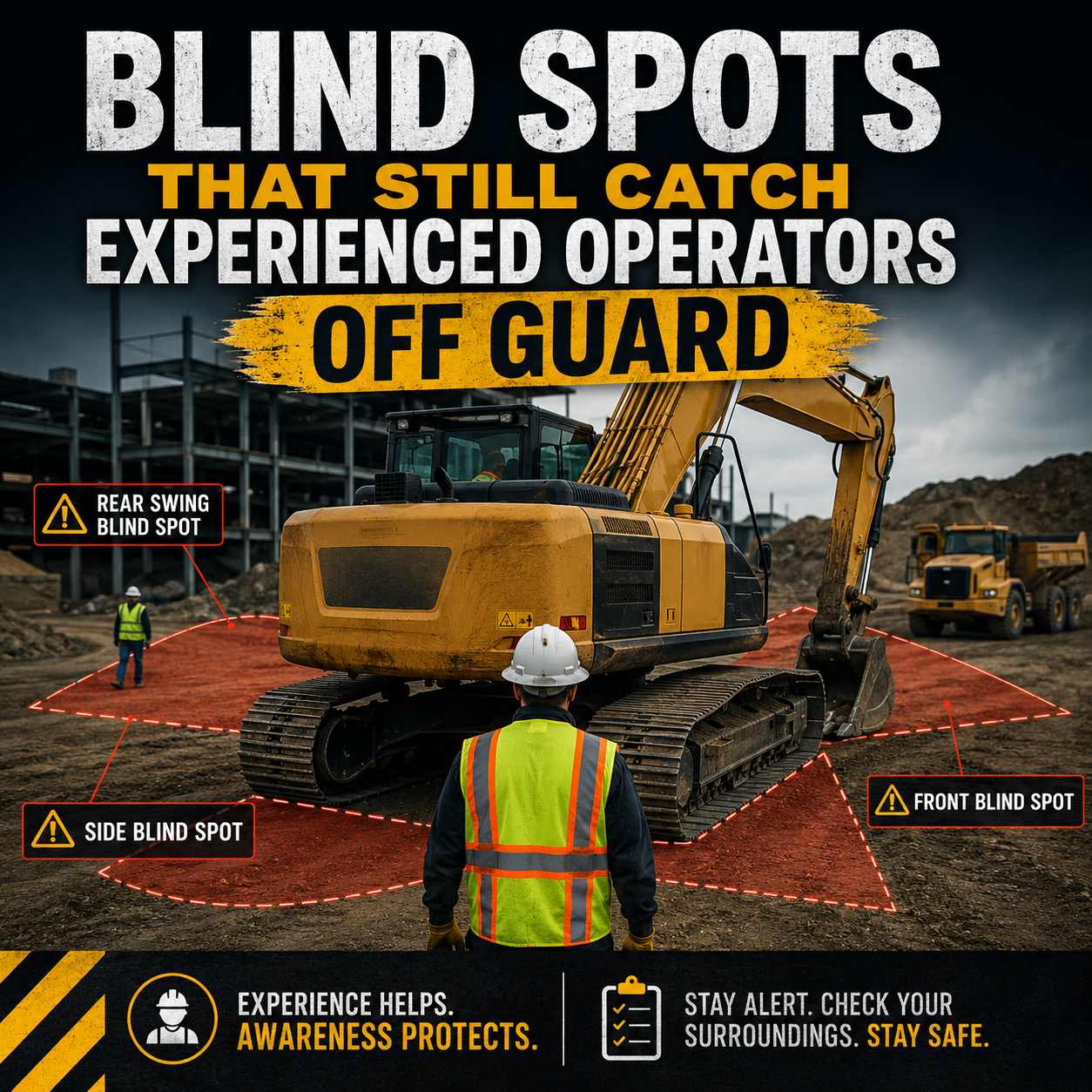
Blind Spots That Still Catch Experienced Operators Off Guard
Experience in heavy equipment operation builds confidence, instinct, and efficiency—but it doesn’t eliminate risk. In fact, some of the most serious incidents on job sites don’t involve beginners. They involve seasoned operators who simply didn’t see something coming.
Blind spots are a perfect example. Even after thousands of hours in the cab, certain visibility gaps, assumptions, and situational oversights continue to cause close calls and costly mistakes. Understanding where these blind spots come from—and how they evolve with experience—is key to staying sharp on any job site.
Why Blind Spots Don’t Disappear With Experience
Most operators learn early on that machines have physical blind spots. Excavators, dozers, loaders, graders, and haul trucks all have areas around them that are partially or completely invisible from the operator’s seat.
What changes with experience isn’t the presence of blind spots—it’s the operator’s confidence in managing them. Over time, familiarity can lead to:
- Assuming a work zone is clear because it usually is
- Relying too heavily on routine rather than active scanning
- Trusting ground personnel or spotters without confirmation
- Becoming desensitized to repetitive site layouts
That comfort is where risk starts to creep back in.
The Most Common Blind Spots That Still Cause Problems
Rear Swing and Counterweight Zones
Excavators and similar machines have a dangerous rear swing radius. Even experienced operators can misjudge how far the counterweight extends when rotating in tight spaces.
The problem often shows up when:
- Working near structures or trench edges
- Swinging in confined urban job sites
- Coordinating with ground crews working “just behind” the machine
A small miscalculation in swing radius can have serious consequences.
Low-Profile Workers and Ground Personnel
One of the most persistent hazards is simply not seeing someone on foot.
Even skilled operators can miss:
- Workers crouching near tracks or tires
- Ground personnel obscured by buckets, blades, or attachments
- High-visibility gear blending into dusty or snowy environments
Fatigue and repetitive tasks increase the risk of “tunnel vision,” where operators focus only on the task interface rather than the broader environment.
Machine-to-Machine Overlap Zones
On busy sites, multiple machines often work in close proximity—loaders, trucks, excavators, and graders all sharing space.
Blind spots become more complex when:
- Another machine blocks your line of sight
- You assume the other operator sees you
- Communication breaks down or becomes non-verbal
Even experienced operators can misjudge how quickly another machine is moving or turning.
Attachment-Extended Blind Spots
Buckets, forks, booms, and blades extend visibility challenges further than many operators expect.
Common issues include:
- Excavator buckets blocking forward ground view
- Loader arms obscuring pedestrians at low carry height
- Dozer blades hiding obstacles or grade changes
The more attachments you use, the more your “true” visibility changes throughout the cycle.
Terrain Changes Outside the Immediate Work Area
Experienced operators often focus tightly on the task zone—digging, loading, grading—but miss changes just outside it.
Examples include:
- Edge collapse near trenches or embankments
- Soft ground forming rutting behind machines
- Uneven haul roads developing over time
These aren’t always “blind spots” in a visual sense—they’re blind spots in attention.
The Psychological Side of Blind Spots
The longer someone operates equipment, the more their brain builds shortcuts. That’s efficient—but not always safe.
Three mental habits often contribute to missed hazards:
Predictive Thinking
Operators assume what should be there based on repetition, not what is there in the moment.
Task Fixation
Focus narrows to a bucket edge, blade angle, or load placement, reducing environmental awareness.
Overconfidence in Familiar Sites
Crews often feel safer on “known” job sites, even though conditions can change daily.
Experience doesn’t reduce blind spots—it just changes how they’re formed.
How Technology Is Helping—but Not Solving—the Problem
Modern machines increasingly include:
- 360-degree camera systems
- Proximity detection and radar
- Cab alerts and object warning systems
These tools are valuable, but they don’t replace operator judgment. They can also be ignored, misinterpreted, or overwhelmed in busy environments.
The most effective safety systems still rely on a combination of:
- Technology
- Communication
- Operator awareness
Remove any one of those, and blind spots return quickly.
Practical Ways Experienced Operators Stay Ahead of Blind Spots
The best operators don’t rely on experience alone—they actively counter it.
Make “Re-checking” a Habit
Even if a zone was clear 10 seconds ago, treat it as unknown again after repositioning.
Slow Down in Transition Moments
Blind spots are most dangerous during:
- Swing transitions
- Reversing
- Loading cycles
- Entering or exiting work zones
Keep Ground Contact Active
Don’t assume silence means safety. Confirm visually or via radio when people are nearby.
Change Perspective Frequently
Small adjustments—slightly raising the boom, shifting seat view, or repositioning—can reveal hidden hazards.
Treat Familiar Sites Like New Sites
Conditions change daily: weather, soil, traffic patterns, and crew positions all shift.
Blind spots are not a beginner problem—they’re a permanent feature of heavy equipment operation. What changes with experience is how subtle and easy they become to overlook.
The most reliable operators aren’t the ones who “know the machine best.” They’re the ones who consistently behave as if something unseen could be waiting just outside their field of view.
Because on a job site, it often is.