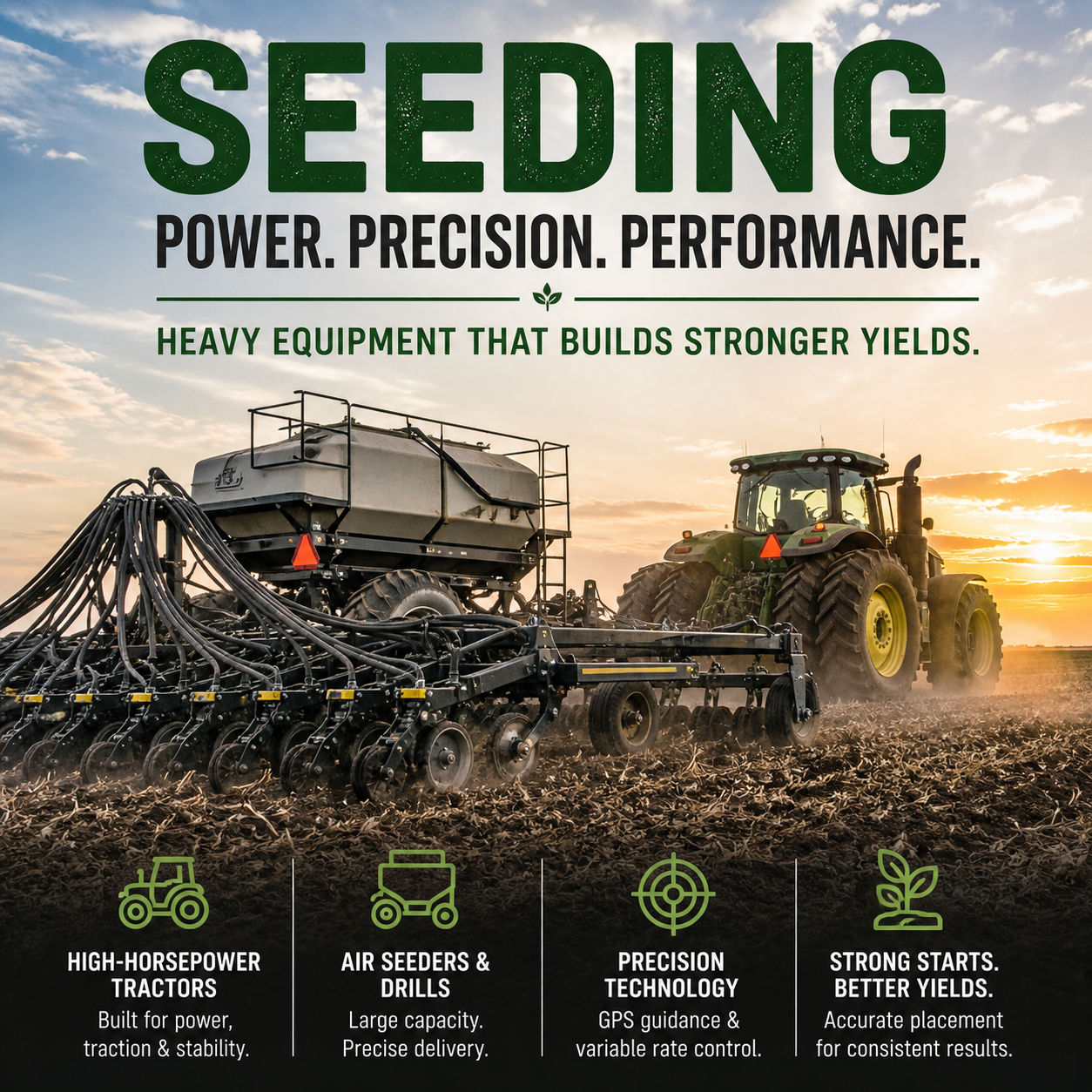
Agriculture Seeding and Heavy Equipment: Where Power Meets Precision
Modern agriculture seeding is no longer just an agronomic task—it’s a heavy equipment operation built on horsepower, hydraulics, and high-precision technology. Today’s seeding systems rely on powerful tractors, sophisticated air delivery systems, and advanced control technologies to place seed accurately across thousands of acres with consistency that would have been impossible a generation ago.
The Role of Heavy Equipment in Seeding
At the center of any seeding operation is the tractor. High-horsepower machines—often ranging from 200 to over 500+ HP—are essential for pulling large air drills or planters through variable field conditions. These tractors are not just about raw power; they’re designed for stability, traction control, and hydraulic capacity to support complex implements.
Manufacturers like John Deere and CNH Industrial (which produces brands such as Case IH and New Holland) have developed tractors specifically optimized for seeding applications, where consistent speed and torque are critical to maintaining uniform seed placement.
Air Drills, Air Seeders, and the Backbone of Modern Seeding
One of the most important pieces of seeding equipment on large-scale farms is the air seeder system. These setups typically include three main components:
- Tractor (power unit)
- Air cart (seed and fertilizer storage and metering system)
- Air drill or toolbar (ground-engaging seeding implement)
The air cart uses a metering system and pressurized airflow to distribute seed and fertilizer evenly through long hoses to the openers at the drill. This system allows for precise application rates while covering large widths—often 40 to 70 feet or more in a single pass.
This integration of mechanical engineering and agronomy is what allows modern farms to seed efficiently at scale.
Precision Placement Through Heavy Iron
Seeding accuracy depends heavily on how well the equipment interacts with the soil. Openers must maintain consistent depth while dealing with uneven terrain, residue, and moisture variability.
Key heavy equipment systems that make this possible include:
- Hydraulic downforce systems that adjust pressure on each row unit in real time
- Parallel linkage systems that keep openers aligned with the soil surface
- Residue management tools that clear crop stubble without disturbing seed zones
- Section control hydraulics that prevent overlap and reduce input waste
These systems work together to ensure seeds are placed at the correct depth and spacing regardless of field conditions.
Power, Weight, and Field Conditions
Seeding equipment is heavy—often extremely so when fully loaded with seed and fertilizer. Air carts alone can carry tens of thousands of pounds of material. This makes weight distribution and traction management critical.
Tracked tractors or dual-wheel configurations are commonly used to reduce soil compaction while maintaining pulling power. In wet or variable spring conditions, flotation becomes just as important as horsepower.
Operators must constantly balance:
- Soil compaction risk
- Traction efficiency
- Fuel consumption
- Seeding speed and accuracy
A well-matched tractor and seeding system can make the difference between efficient fieldwork and costly delays.
Technology Integration: GPS and Variable Rate Seeding
Modern seeding equipment is deeply integrated with precision agriculture systems. GPS guidance ensures perfectly straight passes and eliminates overlap, while variable rate technology (VRT) adjusts seed density based on soil data and yield history.
This allows operators to:
- Increase seeding rates in high-yield zones
- Reduce seed in lower productivity areas
- Optimize fertilizer placement alongside seed
- Maintain consistent emergence across variable terrain
The result is a more efficient use of inputs and a more uniform crop stand.
Operator Skill Still Matters
Even with advanced machinery, operator experience plays a major role in seeding success. Adjusting fan speed on air systems, monitoring hydraulic downforce, and interpreting real-time machine data are all part of the job.
A skilled operator understands how changes in soil moisture, residue levels, or speed affect seed placement. Heavy equipment may do the work, but it still requires informed decision-making in the cab.
Agriculture seeding today is as much about heavy equipment engineering as it is about agronomy. From high-horsepower tractors to precision air delivery systems, every component is designed to deliver one outcome: consistent, efficient, and accurate seed placement across large and variable landscapes.
As machinery continues to evolve, the integration between power and precision will only deepen—pushing modern farming further into a data-driven, equipment-reliant future where every pass across the field is optimized for performance.